- All
- Product Name
- Product Keyword
- Product Model
- Product Summary
- Product Description
- Multi Field Search
English
Views: 0 Author: Site Editor Publish Time: 2026-07-24 Origin: Site

Unpredictable water absorption ruins advanced watercolor techniques. You lay down a wash, and the pigment spreads uncontrollably. The sheet buckles under minimal moisture. Colors dry dull and lifeless. These operational failures frustrate artists and ruin production workflows. Buyers often default to 100% cotton materials expecting immediate durability and performance. However, raw cotton is inherently too absorbent. The actual performance driver is the sizing formulation and application method. Sizing acts as the primary variable in technical evaluation.
This guide provides a technical framework for evaluating how sizing controls absorbency. We explore the mechanics behind moisture control in cotton pulp paper. You will learn how to match manufacturing specifications with specific performance requirements. Understanding these variables enables buyers to predict technique outcomes accurately and avoid costly material failures.
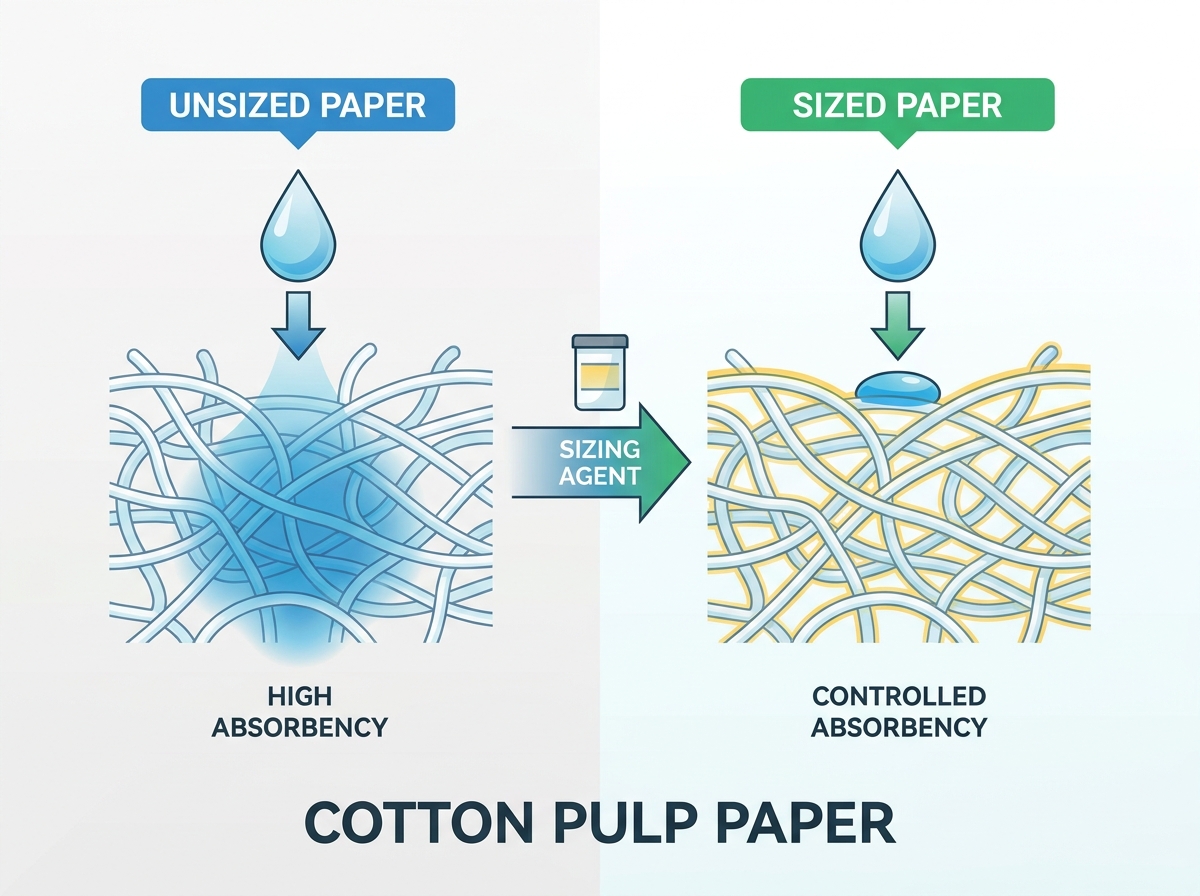
Raw cotton fibers are naturally hydrophilic; without precise sizing, cotton pulp paper acts like a blotter, making controlled watercolor techniques impossible.
Professional-grade papers utilize a dual-sizing approach (internal and external) to control both the structural integrity of the sheet and the surface absorption rate.
The choice between traditional gelatin and synthetic sizing agents directly impacts pigment lifting, wash consistency, and the archival longevity of the paper.
Evaluating paper requires matching the sizing level (hard vs. soft) and paper weight (e.g., 300 gsm / 140 lb) to the specific success criteria of the intended artistic workflow.
Watercolor paper must suspend pigment on the surface. You need time to manipulate the paint before it locks into the fiber matrix. This baseline requirement dictates the success of any wet media application. If the surface absorbs water too fast, you lose control over edges and gradients. If it repels water entirely, the paint beads up and refuses to settle. The physical interaction between water, pigment particles, and the cellulose structure determines the final visual output. Artists rely on a predictable open time. Open time refers to the window where paint remains wet and workable on the sheet. Without a properly engineered surface barrier, this open time drops to zero. You cannot execute complex techniques like graded washes, lifting, or wet-in-wet blending when the moisture vanishes instantly into the core of the sheet.
Cellulose in cotton is highly hydrophilic. The molecular structure of raw cotton actively attracts and holds water molecules. Unsized cotton pulp relies on capillary action, drawing moisture deep into the sheet instantly. This rapid absorption causes immediate pigment sinking. The paint loses vibrancy as it travels away from the surface. Drying times accelerate drastically. You cannot execute smooth washes or lift color when the fibers act like a sponge. The physical anatomy of a cotton fiber includes a hollow center called the lumen. When water hits an unsized sheet, it floods these microscopic channels. Pigment particles follow the water, burying themselves beneath the top layer of fibers. This physical displacement is why unsized paper looks muddy and desaturated once dry. The light hits the top fibers rather than the pigment itself.
Cotton content directly affects paper brightness. Pure cotton fibers offer superior natural brightness compared to wood pulp blends. However, you lose this optical advantage without proper sizing. Unsized fibers allow pigment particles to sink into the dark core of the sheet. This deep penetration dulls the final color. Sizing keeps the pigment near the surface, maximizing light reflection and color intensity. When pigment rests on top of the sizing layer, light passes through the transparent watercolor, hits the white paper underneath, and bounces back to the viewer's eye. This creates the characteristic luminosity of professional watercolor painting. If the pigment sinks, the light scatters among the cellulose fibers, killing the luminous effect. Therefore, the optical performance of the paper relies entirely on the sizing's ability to hold the pigment in the optimal viewing position.
Wood pulp and cotton pulp possess distinct structural characteristics. Wood pulp requires heavy sizing to prevent structural degradation. It pills and tears easily when wet. Cotton fibers are naturally longer and stronger. Therefore, cotton pulp paper relies on sizing strictly for moisture control and pigment suspension. The inherent strength of cotton prevents tearing, allowing the sizing to focus entirely on surface performance. Wood pulp contains lignin, a natural polymer that turns acidic and brittle over time. Manufacturers must chemically remove lignin and heavily size the remaining short fibers just to hold the sheet together under wet conditions. Cotton is naturally lignin-free. Its long, interlocking fibers create a robust mechanical bond during the papermaking process. This means the sizing applied to cotton sheets does not need to act as a structural glue. Instead, it functions purely as a hydrophobic tuning mechanism, giving manufacturers precise control over the paper's absorbency profile.
Test the surface by dropping a single bead of distilled water onto the dry sheet.
Observe the contact angle of the water droplet to gauge the immediate surface resistance.
Time exactly how long it takes for the droplet to fully absorb into the fiber matrix.
Check the reverse side of the sheet to see if moisture penetrated completely through the core.
Apply a standard wash of ultramarine blue and evaluate the edge crispness after drying.
Manufacturers use two primary methods to apply sizing. They utilize internal sizing and external sizing. Each method affects the final product differently. Understanding these approaches helps you evaluate paper quality and predict performance under heavy water loads. A single-sized paper will behave drastically different from a dual-sized paper, even if both are made from identical cotton stock. The application method determines where the hydrophobic barrier lives within the three-dimensional structure of the sheet.
Internal sizing occurs during the initial manufacturing stages. Workers add sizing agents directly into the paper vat before forming the sheets. Alkyl Ketene Dimer (AKD) is a common internal sizing agent. This process coats individual cotton fibers throughout the entire fiber matrix. It prevents the paper from dissolving or structurally failing under heavy water loads. Internal sizing ensures the core remains stable even when the surface is compromised. When the paper machine forms the wet web of fibers, the internal sizing molecules bond directly to the cellulose. As the paper passes through the heated drying cylinders, these bonds cure and harden. This creates a uniform level of water resistance throughout the entire thickness of the paper. If you scratch or scrape the surface of an internally sized sheet, the exposed core will still resist water to a certain degree. This internal stability is what prevents the paper from turning back into mush when artists submerge it in water for stretching.
External sizing applies a protective barrier to the finished sheet. Manufacturers run dried or semi-dried sheets through a bath of sizing. They typically use gelatin or synthetic alternatives for this step. This surface barrier dictates the exact open time for pigment manipulation. It allows artists to build soft edges and achieve even, streak-free washes. External sizing provides the critical working time needed for complex techniques. The tub sizing process physically presses the sizing liquid into the top layers of the paper using heavy rollers. This fills the microscopic valleys between the surface fibers, creating a smoother, more uniform painting area. The external sizing layer acts as a sacrificial barrier. It takes the brunt of the mechanical stress from brushes, sponges, and masking fluid. Without a robust external size, the friction of a stiff brush would immediately lift the surface fibers, causing pilling and ruining the wash.
High-end, professional papers utilize both sizing methods. This dual-sized approach guarantees structural stability and surface control. You should look for dual-sizing in manufacturer specifications. It ensures the paper will handle aggressive scrubbing and heavy washes without deteriorating. Single-sized papers often fail under rigorous professional use. When a sheet features both internal and external sizing, it provides a fail-safe mechanism for the artist. If a heavy scrubbing technique breaks through the external gelatin layer, the internal AKD sizing prevents the water from instantly flooding the core. This layered defense system is the hallmark of premium mill production. It allows for extreme manipulation, multiple glaze layers, and aggressive lifting techniques that would destroy lesser papers.
Sizing Method | Application Stage | Primary Function | Impact on Painting Technique |
|---|---|---|---|
Internal Sizing | Wet vat / Pulp stage | Core structural stability | Prevents buckling and core saturation during heavy washes. |
External Sizing | Dry sheet / Tub bath | Surface moisture control | Dictates open time, pigment suspension, and lifting ability. |
Dual Sizing | Both stages | Comprehensive protection | Allows aggressive scrubbing, masking, and multiple glazes. |
The specific materials used for sizing impact paper performance directly. They affect paint movement, lifting capabilities, and vegan compliance. Evaluating these chemical formulations helps you choose the right paper for your specific studio requirements. The chemistry of the sizing interacts directly with the binder in the watercolor paint, usually gum arabic. This chemical interaction determines how the paint flows, settles, and adheres to the sheet.
Gelatin remains the historical industry standard for external sizing. It provides unique cross-linking properties that deliver superior surface strength. You can aggressively scrub, lift, and apply masking fluid without tearing the cotton fibers. Gelatin offers slow-release absorption. This provides the optimal window for creating smooth, even washes. It prevents premature pooling and patchiness during application. The protein structure of gelatin forms a tough, flexible film over the cotton fibers. When wet, this film swells slightly, allowing a controlled amount of moisture to penetrate while keeping the pigment particles locked on the surface. This swelling behavior is highly predictable, which is why traditional watercolorists prefer gelatin-sized papers. Furthermore, gelatin cures over time, becoming harder and more resilient. This curing process contributes to the archival stability of the paper, protecting the cellulose from environmental pollutants and oxidation.
Modern mills increasingly use synthetic sizing for internal and external applications. Alkyl Ketene Dimer (AKD) and Alkenyl Succinic Anhydride (ASA) are common choices. They offer vegan compliance, chemical consistency, and resistance to biological degradation. However, synthetic sizing involves trade-offs. Poorly formulated synthetic sizing can create a slicker surface. This slickness may repel water too aggressively, complicating wash applications. Synthetic sizes work by forming covalent bonds with the cellulose molecules. This creates a highly efficient hydrophobic barrier. Because they are manufactured chemicals, AKD and ASA offer perfect batch-to-batch consistency, eliminating the natural variations found in animal gelatin. They also do not attract mold or insects, which is a significant advantage for long-term storage in humid climates. However, the water resistance of synthetic sizing can sometimes be too absolute. Water may bead up on the surface rather than spreading evenly, forcing the artist to use wetting agents or ox gall to break the surface tension.
Some manufacturers use starches and plant-based alternatives. Artists also use gum arabic as a post-market additive. You can apply gum arabic to modify the absorbency of degraded papers. It artificially extends wet-on-wet working times. This technique rescues older papers where the original sizing has failed or diminished over time. Plant starches, such as potato or rice starch, offer a softer surface barrier compared to gelatin. They absorb water more readily, making them suitable for printmaking or specific dry-brush techniques. When a paper loses its sizing due to age or improper storage, artists can brush a weak solution of gum arabic and distilled water over the surface. Once dry, this acts as a temporary external size, restoring some of the paper's original handling characteristics. This post-market modification requires careful testing, as too much gum arabic will make the surface brittle and prone to cracking.
Gelatin provides the highest mechanical strength for masking fluid application.
AKD offers superior resistance to mold and biological degradation in humid environments.
Plant starches create a softer, more absorbent surface ideal for printmaking applications.
Gum arabic solutions can temporarily restore surface tension on degraded sheets.
The degree of sizing and physical paper weight map directly to application outcomes. Understanding these conceptual trade-offs helps buyers choose the right specification. You must align the paper's physical properties with your intended artistic techniques. A heavy wash technique requires a completely different paper specification than a dry-brush botanical illustration. The interplay between the thickness of the cotton mat and the hardness of the sizing dictates the paper's operational limits.
Paper weight interacts heavily with sizing performance. Standard weights sit around 300 gsm (140 lb). Heavyweight papers reach 640 gsm (300 lb). Internal sizing prevents warping and buckling across all weights. However, lighter weight papers require more precise surface sizing control. They have lower water saturation thresholds and buckle faster without optimal surface barriers. A 300 gsm sheet relies heavily on its external sizing to prevent water from reaching the core and causing the fibers to expand and warp. If the sizing is too soft, the 300 gsm paper will buckle immediately under a wet wash. Conversely, a 640 gsm sheet has enough physical mass to absorb a significant amount of water before buckling, even if the sizing is slightly softer. This means heavyweight papers offer a larger margin of error for water control, while lighter papers demand strict moisture management from the artist.
Sizing Level | Characteristics | Best For | Trade-offs |
|---|---|---|---|
Heavy Sizing (Hard Sized) | Maximum water resistance, long drying times. | Glazing, precise botanical illustration, high-contrast lifting. | Prone to puddling; requires strict water-to-pigment ratio control. |
Moderate Sizing (Standard) | Balanced absorption, predictable open time. | General watercolor work, smooth even washes, wet-on-wet. | May require stretching for very heavy water applications. |
Low Sizing (Soft Sized) | Rapid absorption, minimal surface barrier. | Printmaking, sumi-e, highly diffused soft-edged techniques. | Impossible to lift pigment; masking fluid will tear the paper. |
Hard sized papers offer maximum water resistance. They feature very long drying times. This makes them ideal for glazing, where you layer paint without disturbing underlying washes. They excel at precise botanical illustration and high-contrast lifting. The primary trade-off is a tendency for water to puddle. You must maintain strict water-to-pigment ratio control. Because the surface repels water so effectively, the pigment sits entirely on top of the sheet. This allows for incredibly vibrant colors and sharp, hard edges. You can easily scrub away dried paint back to the white of the paper. However, executing a large, flat wash on hard-sized paper requires significant skill. The water tends to pool and run, creating unwanted backruns or cauliflowers if the board is not tilted at the correct angle. Artists must constantly manage the bead of water to prevent streaks.
Standard cold press papers feature moderate sizing. They provide balanced absorption and predictable working times. This level suits general watercolor work perfectly. You can achieve smooth even washes and execute standard wet-on-wet techniques. It supports soft edges and reliable color blending. The moderate sizing allows just enough water to penetrate the top layer of fibers to anchor the pigment, while keeping the majority of the moisture on the surface. This balance gives the artist time to work the paint, drop in new colors, and lift out highlights before the wash sets. It is the most versatile specification, accommodating a wide range of painting styles without requiring extreme water management techniques.
Soft sized or waterleaf papers have minimal surface barriers. They absorb water rapidly. These papers work best for printmaking, sumi-e, and highly diffused watercolor techniques. However, they carry significant limitations. You cannot lift pigment once applied. Applying masking fluid will instantly tear the surface fibers. The moment paint touches a soft-sized sheet, it sinks into the core. This creates beautiful, soft, feathery edges that are impossible to achieve on hard-sized paper. It is perfect for loose, expressive painting styles where control is secondary to the natural flow of the medium. However, mistakes are permanent. The pigment locks into the deep fibers immediately, making lifting or correcting impossible. The lack of surface strength also means the paper cannot handle any mechanical stress.
Sized paper faces practical risks in studio environments. Environmental factors and handling techniques can compromise performance. Understanding these implementation risks allows you to mitigate failures and protect your material investment. Paper is a reactive material. It responds to humidity, temperature, and physical handling. Proper storage and preparation are critical to maintaining the integrity of the sizing barrier.
Sizing degrades due to improper storage. High humidity, extreme heat, and oils from human hands break down the chemical barriers. You can easily identify degraded sizing. Symptoms include unpredictable dark spots and spider-webbing of pigment. You may also notice sudden hyper-absorbency and uneven, patchy washes during application. Gelatin sizing is particularly vulnerable to high humidity. Moisture in the air can cause the gelatin to swell and soften, making it susceptible to mold growth. Skin oils transferred during handling act as a resist, preventing water from absorbing evenly and causing white fingerprints to appear in the middle of a wash. To prevent degradation, store paper flat in a dry, climate-controlled environment, preferably wrapped in archival plastic or stored in flat files away from direct sunlight and heat sources.
Soaking paper to stretch it carries inherent risks. Prolonged soaking can wash away external surface sizing. This ruins the paper's ability to suspend pigment. You must implement strict mitigation strategies. Keep soaking times under ten minutes. Use cold water instead of warm water. Warm water dissolves gelatin sizing much faster. Consider utilizing alternative stretching methods like backing boards to protect the surface barrier entirely. When you submerge a sheet of paper, the water attacks the external sizing layer. If you leave the paper in the bath too long, the gelatin will literally dissolve and wash down the drain. This leaves you with a sheet of waterleaf paper that will absorb paint like a sponge. Cold water slows down this dissolution process. Always handle wet paper by the extreme edges to avoid disturbing the softened surface sizing. Once stretched and dried, the paper will regain its surface tension, provided the sizing was not washed away during the soaking phase.
Store all unpainted sheets flat in a climate-controlled environment below 50% humidity.
Handle paper only by the extreme edges to prevent skin oil transfer.
Limit soaking times for stretching to an absolute maximum of ten minutes.
Use only cold water in the stretching bath to preserve gelatin surface barriers.
Test older stock with a clear water glaze before committing to a final painting.
The performance of cotton pulp watercolor paper depends on more than cotton content or paper weight. Because cotton fibers naturally attract water, sizing determines how quickly moisture enters the sheet, how long pigments remain workable, and whether techniques such as lifting, glazing, masking, and wet-on-wet blending can be controlled successfully.
Internal sizing protects the paper’s core during heavy washes, while external sizing regulates surface absorption and strengthens the sheet against brushing and scrubbing. Hard, moderate, and soft-sized papers therefore produce noticeably different painting experiences, even when made from the same cotton fibers.
There is no single sizing level that suits every artist. The right choice depends on the preferred technique, water usage, paper weight, and desired working time. Reviewing manufacturer specifications and testing a small sample with familiar pigments is often the most reliable way to find a paper that behaves predictably in practice.
A: Your paper likely lacks sufficient external sizing. Without a strong surface barrier, the hydrophilic cotton fibers draw water deep into the core instantly. This rapid absorption indicates soft sizing or degraded surface sizing.
A: Yes. You can apply a diluted wash of gum arabic or specialized watercolor sizing fluids over the degraded surface. Let it dry completely before painting. This artificially restores the surface barrier and extends working time.
A: Internal sizing is mixed into the wet pulp to prevent the paper from dissolving when wet. External sizing is applied to the dried surface to control how fast paint absorbs and allow for pigment manipulation.
A: No. While gelatin is the traditional standard for high-end paper, many professional mills now use synthetic sizing agents like AKD or ASA to provide vegan-friendly options with excellent chemical consistency.
A: Prolonged soaking, especially in warm water, dissolves and washes away external sizing. This leaves the paper hyper-absorbent. Always soak in cold water for less than ten minutes to preserve the surface barrier.
A: Yes. Heavier papers like 640 gsm have more mass to absorb water before buckling. Lighter 300 gsm papers rely heavily on surface sizing to prevent saturation and require stretching for heavy washes.
A: Masking fluid tears paper when the surface lacks strong external sizing, usually gelatin. If the paper is soft-sized or the sizing has degraded, the adhesive bonds to the raw fibers and rips them during removal.