- All
- Product Name
- Product Keyword
- Product Model
- Product Summary
- Product Description
- Multi Field Search
English
Views: 0 Author: Site Editor Publish Time: 2026-07-31 Origin: Site

Investing in professional-grade art materials is wasted if the structural foundation cannot support the applied water load, leading to warped surfaces and compromised pigment distribution. Artists and buyers often default to premium materials without understanding the mechanical limits of specific paper weights. Choosing the wrong GSM (Grams per Square Meter) results in either severe buckling (cockling) during wet-on-wet techniques or unnecessary expenditure on overly thick stock. You need a reliable surface that handles moisture predictably. When paper fails, it disrupts the entire painting process, forcing you to fight the material instead of focusing on the artwork. This guide provides a technical evaluation framework for selecting the correct GSM for cotton pulp paper, balancing structural integrity, technique requirements, and cost-efficiency. We will examine the physical properties of different weights and how they interact with various watercolor applications.
Baseline Standard: 300 GSM (140 lb) is the industry-standard baseline for cotton pulp paper, offering the optimal balance between cost and dimensional stability for most watercolor applications.
The Minimum Threshold Rule: Most professional painters strongly advise never going below 300 GSM (140 lb) for wet media, as lighter weights compromise the inherent absorption benefits of cotton.
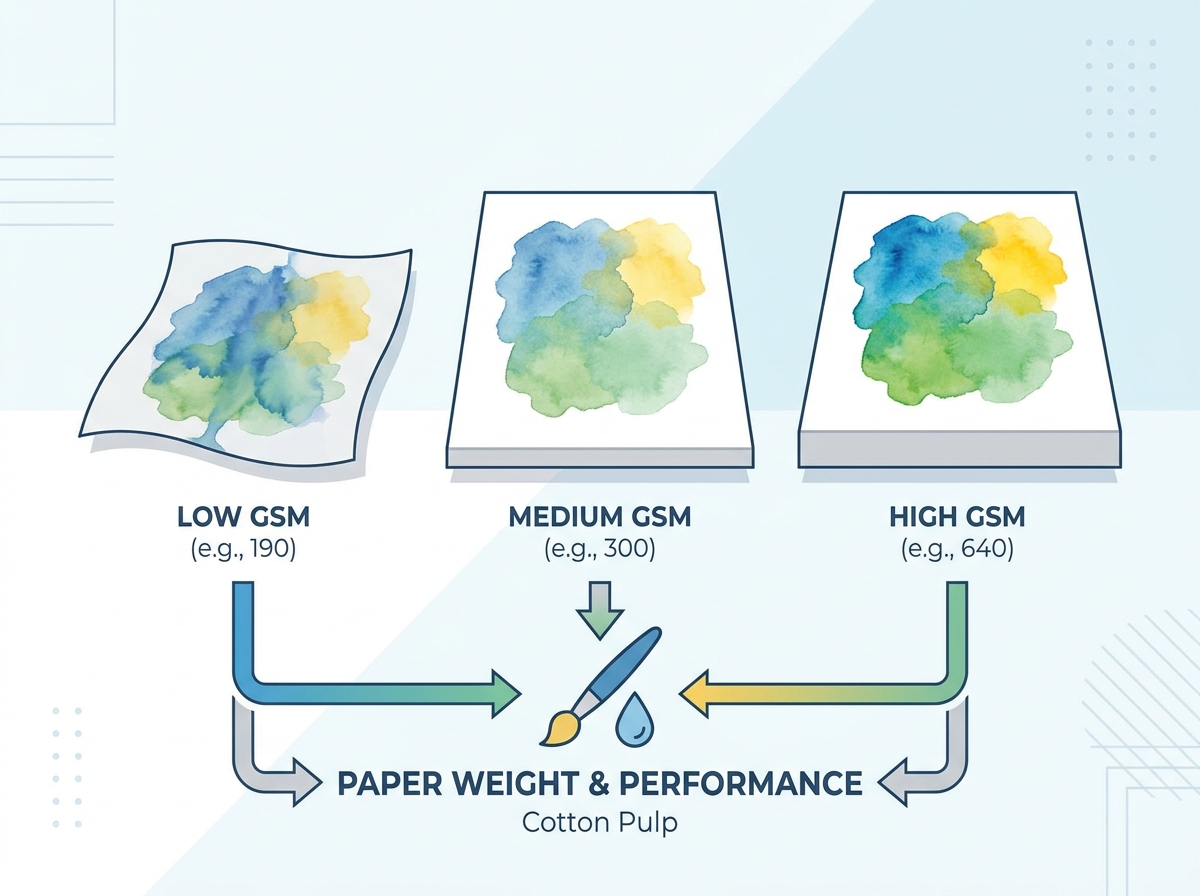
Water Load Dictates Weight: The volume of water used in your workflow is the primary metric for choosing GSM. Heavy washes require 640 GSM (300 lb) to avoid stretching, while dry-brush techniques can succeed on 190 GSM (90 lb).
The Stretching Trade-off: Lower GSM papers require mandatory pre-stretching to prevent cockling, trading lower upfront material costs for increased preparation time and workflow friction.
Fiber Quality Amplifies GSM: 100% cotton pulp paper handles water and aggressive techniques (like scrubbing) significantly better than wood cellulose blends of the exact same GSM due to the physical length and strength of cotton fibers.
Cotton fibers expand when introduced to water. GSM measures the density and thickness of these fibers across a specific area. This density directly dictates the paper's capacity to absorb moisture without warping. Heavier weights contain more fibers, creating a denser matrix that resists the physical distortion caused by heavy water saturation. When you apply a heavy wash, the water penetrates the fiber network. If the network lacks sufficient density, the fibers swell unevenly, causing the sheet to buckle. Understanding this mechanical response helps you anticipate how a specific sheet will behave under your brush.
Cotton fibers possess a natural hollow structure called a lumen. This differs significantly from solid wood pulp fibers. This internal cavity allows cotton to hold water internally rather than just on the surface. Higher GSM cotton pulp paper multiplies this cellular water retention. The increased capacity allows for smoother gradients, longer working times, and even pigment dispersion. Wood pulp fibers tend to let water sit on top, leading to hard edges and unpredictable drying times. The lumen structure gives cotton its signature working properties, making it the preferred choice for serious water media applications.
A successful paper choice must fulfill specific performance criteria during and after the painting process. The paper must dry completely flat without permanent cockling. Pigment dispersion should remain even, avoiding pooling in warped valleys. Finally, the surface sizing must remain intact even after aggressive lifting or scrubbing techniques. If you lift a mistake and the paper pills or tears, the surface has failed. You need a substrate that withstands the physical demands of your specific techniques while maintaining its structural integrity from the first wash to the final details.
Painters often encounter two measurement systems: Grams per Square Meter (GSM) and pounds (lb). GSM is an absolute measurement of density, representing the exact weight of one square meter of a single sheet. Pounds measure the total weight of a specific ream (usually 500 sheets) cut to a specific size. GSM serves as the more precise evaluation metric because it remains consistent regardless of the physical dimensions of the paper you buy. Relying on GSM eliminates the confusion caused by varying ream sizes in the imperial system.
Beginners frequently face confusion when papers prominently display "300 GSM" but actually consist of wood cellulose or cheap blends rather than genuine 100% cotton pulp paper. A 300 GSM cellulose paper will not perform like a 300 GSM cotton paper. Always audit packaging labels carefully. Look for explicit terms like "100% Cotton" or "Rag Paper." Check for manufacturer watermarks. Be highly skeptical of generic designations like "Acid-Free" or "Mixed Media," which often hide inferior wood pulp blends. Manufacturers sometimes use deceptive marketing to sell cheaper cellulose papers at premium prices.
Comparison of Fiber Types at 300 GSM | ||
Feature | 100% Cotton Pulp | Wood Cellulose (Wood Pulp) |
|---|---|---|
Water Retention | High (Internal absorption via lumen) | Low (Surface pooling) |
Durability (Scrubbing) | Excellent (Resists pilling) | Poor (Tears easily when wet) |
Dimensional Stability | Strong (Minimal warping if stretched) | Weak (Prone to severe cockling) |
Pigment Dispersion | Even, smooth gradients | Uneven, hard edges common |
Papers in the 190 GSM range present significant structural limitations. They are highly susceptible to cockling and buckling under moderate to heavy water loads. The thin fiber matrix simply cannot absorb significant moisture without physical distortion. When you apply a wash, the paper will immediately wave, causing pigment to run into the low spots. This creates uneven drying and ruins intended gradients.
Many student-grade papers fall into the 190–200 GSM intermediate trap. These are often cellulose-based pads that frustrate beginners. They mimic professional weights visually but lack the wet-strength of genuine cotton pulp paper. Using 190 GSM requires rigorous stretching before any wet media application. You must soak the paper and tape or staple it to a rigid board to prevent warping. Ideal use cases for this weight include printmaking, dry-brush illustration, quick color studies, and ink-heavy mixed media with minimal water application.
Submerge the 190 GSM sheet in clean water for exactly three minutes.
Remove the sheet and let excess water drip off the corner.
Place the damp sheet flat on a rigid, waterproof board.
Secure all four edges with gummed paper tape, ensuring half the tape covers the paper and half covers the board.
Allow the board to dry completely flat overnight before applying any paint.
The 300 GSM tier offers the best cost-to-performance ratio and stands as the most versatile option available. It is thick enough to handle standard washes and glazing without immediate buckling. Experienced painters consistently recommend 300 GSM as the absolute minimum weight for serious watercolor development. It provides enough structural integrity for most techniques without the extreme cost of heavier boards.
Preparation requirements are manageable. You can use 300 GSM without stretching for light to moderate washes, especially when purchased in a glued block format. Stretching is only required if you plan to execute aggressive wet-on-wet techniques. Ideal use cases span general watercolor painting, plein air work, and commercial illustration. The versatility of 300 GSM makes it the default choice for studios and field work alike.
At 640 GSM, the paper achieves extreme structural integrity, often resembling the rigidity of cardboard. It is capable of absorbing massive amounts of water without any dimensional distortion. This thickness completely eliminates the need for pre-stretching. You can drop heavy washes directly onto the dry sheet without fear of cockling.
A zero-stretch workflow saves significant preparation time and mitigates the risk of damaging the surface sizing during the soaking process. Ideal use cases for 640 GSM include heavy wet-on-wet techniques, aggressive scrubbing and lifting, pouring watercolors, and exhibition-grade commission work where structural failure is unacceptable. The high upfront cost is offset by the time saved and the absolute reliability of the surface.
High-capacity water techniques demand substantial fiber density. Wet-on-wet painting requires 300 GSM (minimum, if stretched) or 640 GSM (unstretched) to prevent pigment from pooling in warped valleys. If the paper buckles while wet, the water and pigment will flow into the low points, ruining intended gradients and causing uneven drying patterns. You need a surface that remains flat while saturated. 640 GSM excels here, allowing you to flood the paper with water and drop in pigment with complete control over the dispersion.
Glazing involves applying multiple transparent layers of pigment over dry washes. A 300 GSM cotton pulp paper supports this process effectively. The internal and external gelatin sizing prevents the paper from turning into a sponge. Heavier weights retain this sizing better through multiple wetting and drying cycles, ensuring subsequent layers do not disturb the underlying pigment. If you use a lighter weight, the repeated application of water can break down the sizing, causing the new layer to lift the old layer, resulting in muddy colors.
Techniques that physically stress the paper surface require high durability. Heavier weights (300 GSM and above) provide the necessary structural strength to withstand masking fluid removal and stiff-bristle scrubbing. Lighter papers will pill, tear, or lose their sizing entirely when subjected to these aggressive techniques, permanently damaging the cotton fibers. When you need to lift a highlight using a stiff brush and clean water, a 640 GSM sheet will release the pigment while keeping the paper surface intact. A 190 GSM sheet will likely disintegrate under the same pressure.
Technique Compatibility by GSM | |||
Technique | 190 GSM | 300 GSM | 640 GSM |
|---|---|---|---|
Dry Brush | Excellent | Excellent | Excellent |
Light Washes | Fair (Requires stretching) | Excellent | Excellent |
Heavy Wet-on-Wet | Poor (Will buckle severely) | Good (Requires stretching) | Excellent (No prep needed) |
Aggressive Scrubbing | Poor (Will tear) | Good | Excellent |
Selecting paper weight involves a direct trade-off between time and material costs. Buying cheaper 190 GSM paper saves money upfront but costs significant time in stretching and carries the constant risk of ruined paintings due to buckling. Conversely, investing in 640 GSM paper requires a high upfront cost but offers zero prep time and maximum reliability. You must calculate the value of your studio time. If you spend an hour stretching paper for every painting session, the cheaper paper actually costs you more in lost productivity.
The format in which you buy paper impacts both cost and the necessity of heavier weights. Buying 300 GSM in glued blocks provides tension on all four sides, reducing the need to stretch for moderate washes. Loose sheets are cheaper but require manual stretching. Wire-bound sketchbooks offer convenience but provide no structural tension, making 300 GSM the absolute minimum requirement for sketchbook work. Rolls offer the best square-foot value but require cutting and flattening before use, adding another step to your preparation workflow.
Heavier cotton pulp papers generally offer better long-term durability. The thicker fiber matrix provides superior resistance to environmental degradation, handling wear, and minor physical damage compared to lighter weights. For artwork intended for framing and long-term display, heavier GSM ensures the structural foundation remains intact for decades. Thin papers are more susceptible to creasing, tearing, and humidity fluctuations over time. Investing in heavier stock protects the physical integrity of the finished piece.
Over-soaking lighter GSM papers during the stretching process can wash away the external gelatin sizing. When sizing is lost, the paper becomes overly absorbent, leading to dull, sunken colors and unpredictable pigment spread. The paint will sink directly into the fibers instead of sitting on the surface, making it impossible to achieve vibrant washes or crisp edges.
Mitigation involves careful water management. Use 300 GSM glued blocks to avoid soaking entirely. If you must stretch 190 GSM paper, strictly limit the soaking time to three minutes or less to prevent sizing loss. Always use cold water, as warm water dissolves gelatin sizing much faster.
GSM behaves differently across various surface textures. A 300 GSM Hot Press (smooth) paper may show buckling faster than a 300 GSM Rough paper. The Rough paper has a higher surface area and different fiber compression, altering how it handles initial water loads. The smooth surface of Hot Press allows water to pool rapidly, while the peaks and valleys of Rough paper distribute the moisture more evenly.
Mitigation requires testing. Buy sample packs of specific texture and GSM combinations before committing to bulk purchases. Your specific technique may interact differently with smooth versus textured surfaces. A wash that works perfectly on 300 GSM Cold Press might pool uncontrollably on 300 GSM Hot Press.
A major risk is purchasing paper labeled "300 GSM" that is actually a wood-pulp and cotton blend. These blends will not perform to the standards of 100% cotton pulp paper, lacking the specific water retention and durability required for professional techniques. You will experience unexpected buckling, poor lifting capabilities, and dull color reproduction.
Mitigation relies on strict verification. Check manufacturer specifications explicitly stating "100% cotton." Look for established watermarks embedded in the paper sheet, which indicate professional-grade manufacturing. Hold the sheet up to the light to find the watermark. If the packaging only says "watercolor paper" without specifying the fiber content, assume it is a cellulose blend.
Selecting the correct paper weight dictates the success of your watercolor techniques. You must match the physical properties of the paper to the demands of your specific workflow. Proper selection prevents frustration, saves time, and ensures your materials support your artistic intent rather than fighting against it.
Evaluate your typical water load to determine if you need the extreme stability of 640 GSM or the versatile balance of 300 GSM.
Purchase a 300 GSM cold-press block to test moderate washes without the need for manual stretching.
Audit your current paper supply by checking watermarks and packaging to confirm you are using genuine 100% cotton stock.
Test a small sample of 190 GSM paper with your standard stretching method to see if the cost savings justify the preparation time.
Reach out via our contact us page to request technical specifications or discuss bulk ordering options for your studio.
A: It depends on your water load. For light to moderate washes, 300 GSM usually does not require stretching, especially if used in a glued block. However, for heavy wet-on-wet techniques, stretching 300 GSM is recommended to prevent minor buckling.
A: They refer to the same thickness. GSM (Grams per Square Meter) is the metric measurement of paper density. 140 lb is the imperial measurement, indicating the weight of a specific ream (500 sheets) of that paper. 300 GSM is the more precise and universal metric.
A: You can use 200 GSM, but it requires mandatory stretching to prevent severe buckling. At 200 GSM, wood pulp paper will warp heavily and resist pigment absorption, while cotton pulp will handle water slightly better but still lacks the structural rigidity needed for heavy washes.
A: Buckling occurs when the volume of water applied exceeds the paper's capacity to absorb it evenly. Even 300 GSM will buckle under very heavy wet-on-wet applications if it is not pre-stretched or secured on a glued block.
A: Yes. 100% cotton paper has longer, stronger fibers with natural hollow lumens that absorb water internally. Cellulose (wood pulp) fibers are shorter and hold water mostly on the surface, making cellulose much more prone to warping and surface damage at the exact same GSM.
A: Texture alters surface area. A 300 GSM Hot Press (smooth) paper may buckle slightly faster than a 300 GSM Rough paper because the smooth surface forces water to sit differently, whereas the rough texture disperses the moisture across a varied topography.
A: Look for explicit "100% Cotton" or "100% Rag" labeling on the packaging. Professional cotton papers often feature an embossed watermark. Avoid papers labeled simply "Acid-Free" or "Watercolor Paper" without stating the fiber content, as these are usually cellulose blends.