- All
- Product Name
- Product Keyword
- Product Model
- Product Summary
- Product Description
- Multi Field Search
English
Views: 0 Author: Site Editor Publish Time: 2026-07-28 Origin: Site

Selecting the incorrect paper substrate carries an irreversible risk of material degradation in professional art, archiving, and institutional preservation. Historical documents, fine art, and critical records can yellow, become brittle, and disintegrate within decades if the base material lacks true chemical stability. The core problem lies in the ambiguity of paper manufacturing marketing. Terms like "acid-free," "conservation-grade," and "archival" are frequently conflated. This confusion often masks the underlying pulp quality and chemical stability of the product. Buyers must navigate these terms carefully to ensure long-term preservation.
While cotton pulp paper stands as the gold standard for longevity, procurement requires evaluating specific manufacturing variables. Lignin content, buffering capacity, and sizing agents dictate whether a paper will survive centuries or degrade rapidly. You must look past surface-level marketing claims to guarantee true archival performance. Understanding the molecular differences between raw materials is the first step in making an informed selection.
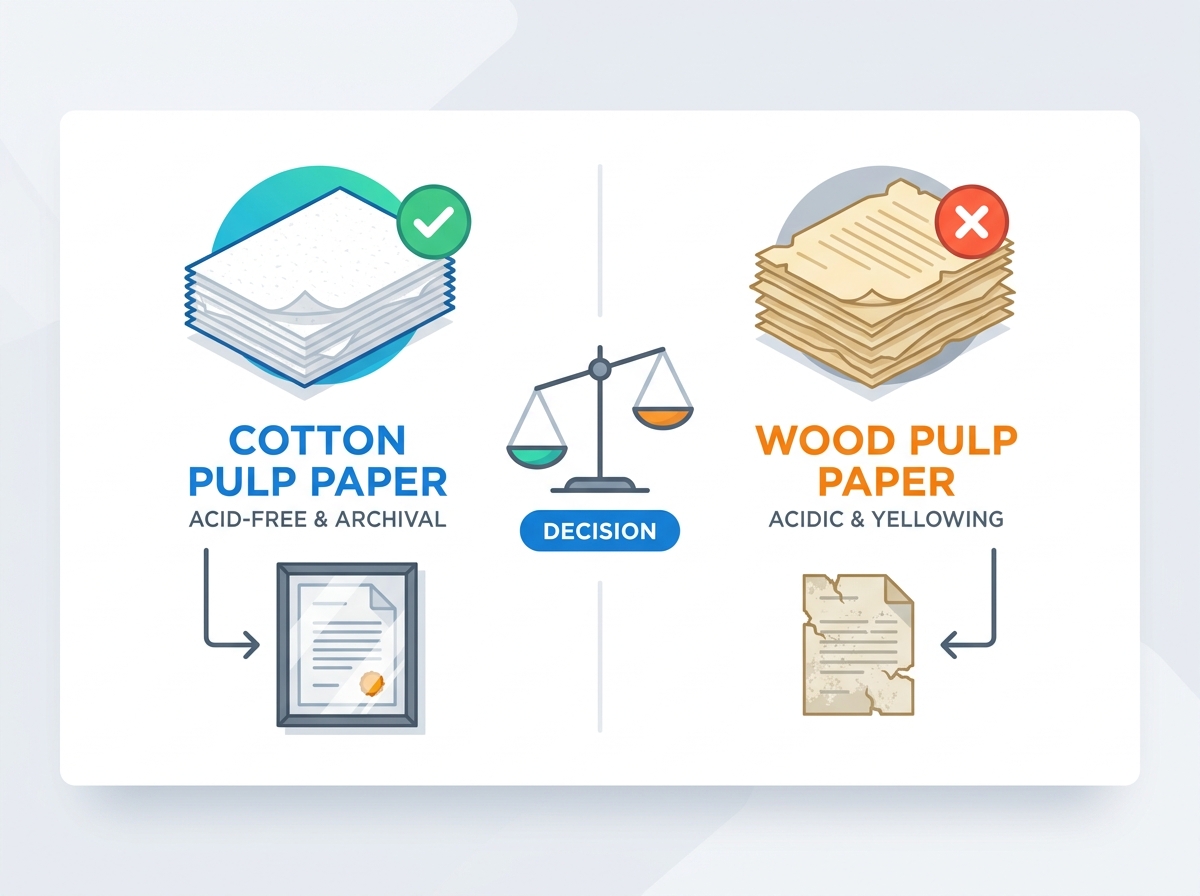
Inherent Stability: Cotton pulp paper is naturally lignin-free and composed of nearly 100% pure cellulose, making it up to 10 times stronger than standard wood cellulose.
Acid-Free vs. Archival: "Acid-free" only indicates a neutral or alkaline pH at the time of manufacturing; "archival" (or museum-grade) requires strict structural integrity and the absolute absence of lignin, which cotton naturally provides.
The Buffering Requirement: Even naturally acid-free cotton paper requires an alkaline buffer (typically calcium carbonate) to neutralize future environmental acidity.
Verification is Critical: Procurement requires verifying ISO standards (e.g., ISO 9706) rather than relying on unregulated "archival" marketing claims.
Achieving multi-century preservation without yellowing or embrittlement requires a chemically stable base substrate. The material must be entirely free of compounds that break down into acids over time. Preservation success relies directly on the molecular purity of the fibers used during the initial manufacturing process. When evaluating substrates for permanent records or fine art, the chemical baseline dictates the physical lifespan of the object.
The molecular structure of cotton consists of nearly 100% pure alpha-cellulose. This high purity level provides unmatched chemical stability. Wood pulp contains significantly lower percentages of alpha-cellulose and includes high amounts of hemicellulose and lignin. To reach usable purity levels, wood pulp requires extensive chemical processing, including aggressive bleaching and cooking. This processing inherently weakens the core fiber structure, leaving it susceptible to future degradation.
Cotton offers a distinct mechanical advantage. Cotton fibers are naturally longer and interlock more securely during the paper-making process. This interlocking structure provides superior tensile strength and exceptional resistance to physical wear. In practical applications, cotton cellulose is up to 10 times stronger than standard wood cellulose. It withstands heavy handling, folding, and environmental stress. When tested on an MIT Fold Endurance tester, high-quality cotton sheets can withstand thousands of double folds before breaking, whereas standard wood pulp sheets often fail after a few dozen.
Chemically purified wood pulp carries a high risk of "acid-reversion." Wood fibers retain residual processing chemicals that can degrade the material over time. These hidden chemicals react with environmental moisture and ambient heat to form destructive acids internally. Cotton requires minimal chemical processing, virtually eliminating the risk of internal acid generation. The raw cotton fibers are simply washed, beaten, and formed into sheets, preserving their natural polymeric strength.
Lignin is a natural polymer found in wood that binds cellulose fibers together, giving trees their rigid structure. While useful in living plants, lignin is highly detrimental in manufactured paper. It oxidizes rapidly upon exposure to ultraviolet light and atmospheric oxygen. This oxidation process produces acids that cause the paper to yellow, darken, and become severely brittle. You can observe this rapid degradation in standard newsprint, which turns yellow and crumbles after just a few days in direct sunlight.
Cotton is naturally lignin-free. This inherent characteristic eliminates the primary catalyst for paper degradation. Manufacturers do not need to subject cotton to harsh chemical extraction processes to remove lignin, because it simply isn't there. The absence of lignin ensures the paper remains structurally sound and visually unchanged for centuries. When archiving documents that must remain legible and intact for 500 years, starting with a lignin-free base is a non-negotiable requirement.
Industry-standard classifications used by institutions like the Preservation Self-Assessment Program (PSAP) help categorize paper stability. Understanding these classifications prevents costly procurement errors. You must differentiate between temporary chemical treatments and permanent molecular stability. Misunderstanding these terms often leads institutions to invest in materials that fail decades before their expected lifespan.
The term "acid-free" refers specifically to alkaline paper-making technology. During formation, the pH of the pulp is maintained above 7.0, ensuring a neutral or alkaline state. This prevents the immediate introduction of acids during the manufacturing phase. Historically, paper was made using acidic alum-rosin sizing, which caused widespread degradation in 19th and 20th-century books. Modern acid-free processes were developed to halt this immediate self-destruction.
However, "acid-free" has a critical limitation. Manufacturers can chemically treat wood pulp to be acid-free temporarily. Residual chemicals, environmental pollutants, or the breakdown of synthetic buffers can cause acidity to return. An acid-free label does not guarantee permanent preservation if the base fiber is unstable. If a paper contains lignin but is buffered to a pH of 7.5, it is technically "acid-free" at the point of sale, but it will inevitably become acidic as the lignin oxidizes.
Conservation-grade paper typically consists of chemically purified wood pulp, known as high-alpha cellulose. Manufacturers treat this pulp to be acid-free and add an alkaline buffer. It is highly stable and suitable for long-term preservation, but it does not offer indefinite longevity. Institutions often use conservation-grade materials for housing secondary collections or printing materials expected to last 50 to 100 years.
Archival-grade, or museum-grade, paper is strictly composed of 100% cotton rag or cotton linters. It is naturally acid-free, completely lignin-free, and includes an alkaline buffer. This grade represents the highest standard for permanent preservation. It is reserved for original artwork, primary historical documents, and items requiring multi-century stability.
The distinction lies in the reliance on chemical additives. Conservation-grade relies on these additives to remain neutral over time. Archival-grade paper is naturally stable at a molecular level, requiring buffers only to combat external environmental threats. The table below outlines the specific differences between these grades.
Specification | Conservation-Grade | Archival-Grade (Museum-Grade) |
|---|---|---|
Base Material | Chemically purified wood pulp (High-alpha cellulose) | 100% Cotton Rag or Cotton Linters |
Lignin Content | Chemically removed (trace amounts may remain) | Naturally 100% Lignin-Free |
Acid-Free Status | Achieved via chemical treatment | Naturally acid-free |
Longevity Expectation | Long-term (50 to 100 years) | Indefinite (300+ years) |
Mechanical Strength | Moderate fold endurance | Exceptional fold endurance and tear resistance |
Assessing a manufacturer's specification sheet is mandatory to ensure the material meets true archival success criteria. You must look beyond basic marketing terms and evaluate specific chemical properties. Proper auditing prevents premature material failure and protects institutional investments. When reviewing technical data sheets, focus on buffering, sizing, and optical additives.
Even naturally acid-free cotton needs protection from atmospheric pollutants like sulfur dioxide and nitrogen oxides found in urban environments. It also requires defense against acidic storage materials, such as wooden drawers or non-archival folders. An alkaline buffer acts as a sacrificial shield, neutralizing external acids before they can attack the cellulose fibers. Without this buffer, the pure cotton would eventually absorb ambient acidity and begin to degrade.
Acid migration is a constant threat in archiving. Acids from human hands, mounting boards, or adhesives can migrate directly into the paper through physical contact. The buffer neutralizes this threat upon contact, preserving the structural integrity of the sheet. This is particularly important for artwork that may be framed using standard, acidic mat boards by end-users.
True archival standards require a 2% to 3% calcium carbonate reserve. This specific concentration ensures sufficient neutralizing capacity to combat future acid migration over hundreds of years. Magnesium carbonate is also occasionally used, but calcium carbonate remains the industry standard. Always verify this percentage on the technical data sheet before approving a purchase.
Sizing controls the absorption rate of the paper. Internal sizing is mixed directly into the pulp vat, coating the fibers before the sheet is formed. External sizing (or surface sizing) is applied to the surface of the formed sheet, often in a size press or bath. Both impact how the paper handles moisture, inks, and environmental humidity. Proper sizing prevents ink from feathering and protects the internal fibers from immediate moisture penetration.
Acidic sizing, like alum-rosin historically used in paper-making, destroys archival integrity by introducing sulfuric acid into the sheet. Modern archival paper necessitates synthetic, neutral sizing such as Alkyl Ketene Dimer (AKD) or Alkenyl Succinic Anhydride (ASA). These synthetic sizes cure at neutral or alkaline pH levels. Traditional gelatin sizing, often used in high-end watercolor papers, also maintains structural integrity without introducing harmful acids, provided it is applied correctly and protected from biological attack.
Manufacturers often use Optical Brightening Agents (OBAs) to make paper appear artificially whiter. These chemical additives absorb invisible ultraviolet light and re-emit it in the visible blue spectrum. This creates a brilliant, high-contrast surface favored in commercial printing and modern photography. OBAs mask the natural warm, slightly off-white tone of pure cotton fibers.
OBAs present a severe implementation risk for preservation. They break down over time under UV light exposure, causing unpredictable color shifts and rapid yellowing. As the OBAs lose their fluorescence, the paper reverts to its natural color, which appears as a yellow shift to the viewer. True archival material must be explicitly labeled OBA-free to ensure permanent color stability. You can test for OBAs by examining the paper under a UV blacklight; OBA-free paper will remain dull, while paper with OBAs will glow brightly.
Balancing budget, application requirements, and material longevity requires understanding conceptual trade-offs. Not all projects demand the highest tier of archival material. Selecting the right substrate involves matching the fiber characteristics to the specific use case. Over-specifying materials wastes budget, while under-specifying risks catastrophic loss of information or art.
Paper made from textile remnants is known as cotton rag. It features the longest fibers, providing the highest mechanical strength and durability. Consequently, it carries the highest cost due to the complex sourcing and processing of textile waste. Cotton linters, or cotton pulp, utilize shorter fibers sourced directly from the cotton seed after the long fibers are removed for textiles. It is slightly less durable than rag but significantly more affordable and easier to process.
Fiber length directly correlates with fold endurance and mechanical longevity. Longer rag fibers withstand repeated handling and folding without snapping. Shorter linter fibers offer excellent chemical stability but slightly lower resistance to aggressive mechanical stress. For most fine art and archival document applications, high-quality cotton linters provide more than enough strength while keeping costs manageable.
The premium cost of 100% cotton is justified for original fine art, legal documents, museum archives, and high-end photography. These applications demand indefinite preservation and maximum mechanical strength. The return on investment is measured in centuries of stability. When the cost of replacing or restoring a degraded document far exceeds the initial material cost, cotton is the only logical choice.
High-alpha wood pulp is a viable, cost-effective alternative for reproductions, short-term displays, and standard documentation. When the preservation window is decades rather than centuries, conservation-grade wood pulp provides adequate protection at a fraction of the cost. Institutions must audit their collections and assign material grades based on the expected retention schedule of the specific items.
Cotton handles heavy water saturation significantly better than wood pulp equivalents. The fibers swell uniformly and return to their original state without severe warping or buckling. This makes it ideal for wet media, such as watercolor, and complex printing processes like intaglio or platinum-palladium printing, which require soaking the paper.
It also offers superior pigment absorption and withstands mechanical stress like erasing, scraping, or masking fluid removal. Wood pulp fibers tend to tear, pill, or rupture under similar friction. The structural resilience of cotton ensures the surface remains intact during rigorous application, allowing artists and conservators to work the surface without destroying the substrate.
Purchasing substandard paper disguised by misleading terminology is a common risk in the materials market. You must actively mitigate this by scrutinizing technical specifications and demanding proof of compliance. Relying on unregulated marketing buzzwords often leads to preservation failures that are not discovered until decades later, when the damage is irreversible.
Beware of terms like "acid-free" used in isolation. If a spec sheet mentions acid-free without explicitly stating "lignin-free" or detailing the fiber composition, exercise extreme caution. The term "wood-free" is particularly deceptive; it actually means wood-pulp-based paper that has had lignin chemically removed, not true cotton. It is a legacy industry term that confuses many buyers.
Scrutinize the word "archival" when used as a marketing buzzword rather than a quantifiable specification. True archival status requires specific chemical benchmarks. If a manufacturer cannot provide exact details on buffering percentages, sizing chemistry, and fiber purity, the product likely falls short of museum standards. Always demand a comprehensive Technical Data Sheet (TDS) before making a decision.
Buyers must look for verifiable standards before finalizing procurement. ISO 9706 (Information and documentation — Paper for documents — Requirements for permanence) is the definitive standard for chemical stability. Compliance with this standard guarantees the paper meets strict criteria for buffering (minimum 2% alkaline reserve), tear resistance, and lignin absence (Kappa number less than 5.0).
If the material is used for photographic archiving, verify compliance with the Photographic Activity Test (PAT) ISO 18916. This ensures the paper will not react chemically with photographic emulsions, causing fading or silver mirroring. When sourcing cotton pulp paper for institutional use, always request documentation proving adherence to these independent testing protocols. Do not accept internal manufacturer testing as the sole proof of compliance.
While cotton pulp paper is inherently the best foundation for archival stability due to its pure cellulose and lack of lignin, raw material alone is not enough. It must be manufactured with alkaline buffering and neutral sizing to be truly archival. Without these specific manufacturing controls, even 100% cotton is vulnerable to environmental degradation and acid migration.
Execute the following steps to ensure proper procurement:
Request comprehensive technical data sheets (TDS) directly from manufacturers to verify fiber composition and chemical metrics.
Audit the specifications to confirm a 100% cotton base, strict lignin-free certification, and a 2-3% calcium carbonate alkaline buffer.
Order physical sample packs to conduct on-site mechanical testing for fold endurance, surface strength, and water handling.
Test the samples under a UV blacklight to confirm the absolute absence of Optical Brightening Agents (OBAs).
Require documented proof of ISO 9706 compliance before executing any bulk purchasing agreements.
A: No. While cotton is naturally lignin-free, the manufacturing process dictates its final pH. The water source, chemical additives, and sizing agents must be strictly neutral or alkaline to guarantee the finished paper remains acid-free. If a mill uses acidic sizing on cotton fibers, the resulting paper will be acidic and prone to degradation.
A: The difference lies in fiber length and source. Cotton rag utilizes long fibers from textile remnants, offering maximum mechanical strength and fold endurance. Cotton pulp (linters) uses shorter fibers from raw cotton seeds, providing excellent chemical stability but slightly lower resistance to heavy physical wear.
A: High-alpha cellulose wood pulp can meet conservation-grade standards if properly delignified and buffered. It is highly stable for long-term use but technically ranks below 100% cotton for permanent, multi-century preservation due to the harsh chemical processing required to purify the wood fibers.
A: Acid-free wood pulp turns yellow if residual lignin oxidizes over time. Additionally, if the artificial alkaline buffer depletes due to environmental exposure, the paper experiences acid-reversion. This allows internal and external acids to attack the cellulose, leading to embrittlement and yellowing.
A: Based on ISO 9706 compliance, 100% cotton archival paper can last hundreds of years. Proper environmental conditions, including controlled humidity, stable temperature, and protection from UV light, are required to achieve this maximum lifespan.
A: Yes. Buffering is necessary to protect against external environmental acids and acid migration from handling or adjacent storage materials. A calcium carbonate reserve neutralizes these threats, even though the cotton itself is naturally acid-free.
A: "Wood-free" is a confusing industry term for chemical wood pulp where the lignin has been removed. It is still entirely wood-based and is structurally and chemically inferior to true cotton paper. It does not mean the paper is made from cotton or alternative fibers.