- All
- Product Name
- Product Keyword
- Product Model
- Product Summary
- Product Description
- Multi Field Search
English
Views: 0 Author: Site Editor Publish Time: 2026-07-14 Origin: Site

The most significant variable in watercolor painting outcomes is not the pigment or the brush. It is the structural composition and purity of the paper. Artists face a budget-versus-performance dilemma, weighing the high cost of premium paper against the unpredictable behavior of cheaper cellulose blends. Misunderstanding how fiber composition dictates water control leads to wasted materials, pigment pooling, and compromised artwork. We offer an objective, technical breakdown of 50% versus 100% cotton pulp paper. We evaluate how cellulose blends, manufacturing impurities, and pure cotton fibers impact absorbency, surface brightness, durability, and archival quality. This detailed analysis helps artists make evidence-based purchasing decisions and optimize their studio practices for both practice sketches and final gallery pieces.
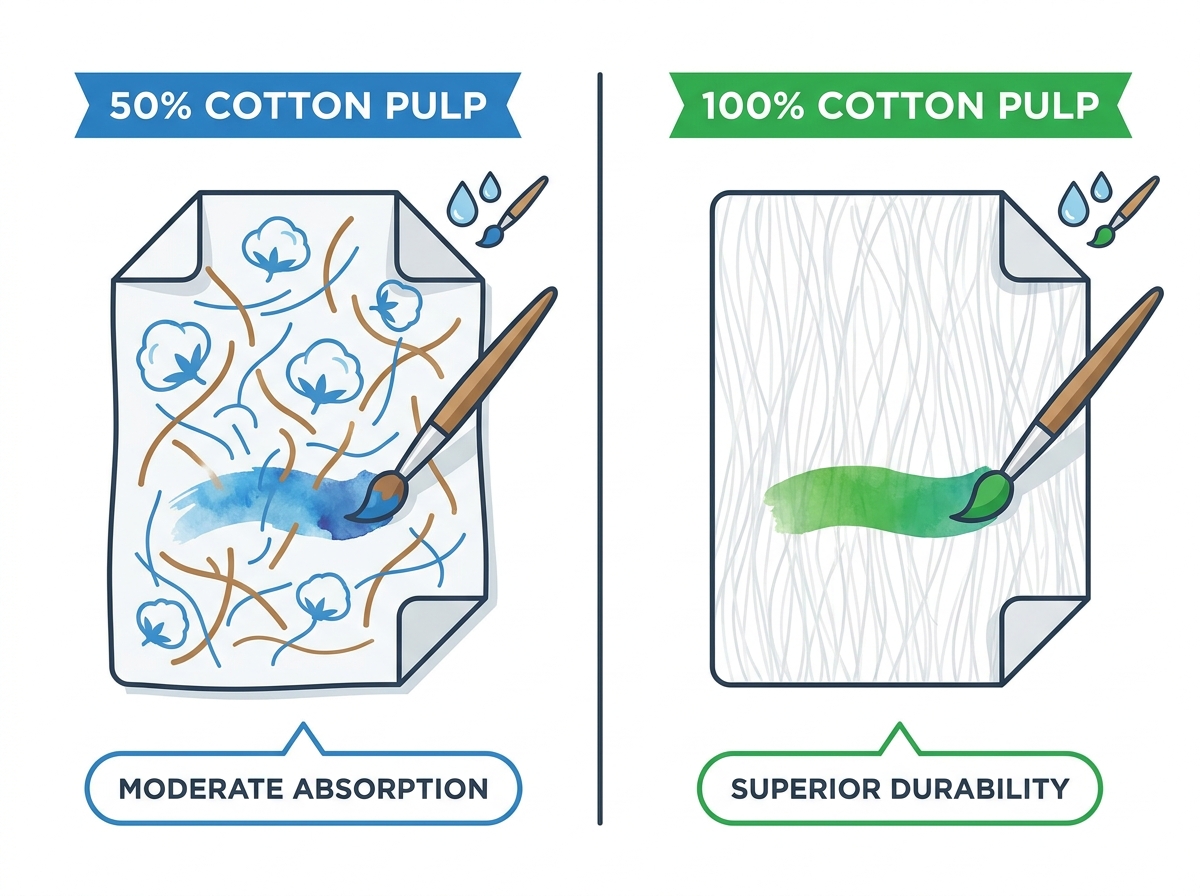
Water Handling: 100% cotton pulp paper offers superior capillary action, long moisture retention, and even dispersion, making it mandatory for complex wet-on-wet techniques.
The "Precious Paper" Paradox: While 100% cotton is technically superior, its high cost can cause psychological paralysis (fear of wasting paper), making 50% blends a critical tool for high-volume practice and uninhibited creative experimentation.
Optical Brightness and Color: The percentage of cotton directly impacts natural reflectivity. 100% cotton provides a stable, naturally bright surface without relying heavily on chemical optical brightening agents (OBAs) that degrade over time.
Durability & Lifting: Pure cotton fibers withstand aggressive scrubbing, lifting, and masking fluids; 50% blends are prone to surface pilling and tearing under mechanical stress.
Archival Integrity: 100% cotton is naturally lignin-free and acid-free, resisting yellowing. 50% blends contain wood pulp (cellulose) that retains organic impurities and relies on chemical buffering to delay acidic degradation.
Clarify the terminology before selecting materials for your studio. Cotton linters are the raw, short fibers left on the cottonseed after the longer staple fibers are removed for textiles. These linters form the basis for high-quality watercolor pulp. Cotton rag traditionally meant recycled textile fibers, but modern mills mostly use linters to ensure consistency and avoid synthetic contaminants found in modern clothing. Alpha-cellulose refers to highly processed wood pulp. Manufacturers chemically strip lignins from wood pulp to mimic the properties of cotton, creating a substrate that behaves somewhat like cotton but lacks its inherent structural advantages.
The distinction between these materials dictates how the paper will perform under heavy water loads. When a manufacturer labels a product as a blend, they are mixing these highly processed wood fibers with cotton linters. The ratio of this mix fundamentally alters the capillary action of the sheet. Understanding this baseline chemistry is the first step in mastering water control.
Cotton possesses a near-pure cellulose molecular structure right out of the field. It requires minimal chemical intervention to become a stable, archival painting surface. Wood pulp naturally contains lignins and hemicellulose. These organic compounds are the structural glue of a tree, but in paper, they cause rot, embrittlement, and severe yellowing over time. Manufacturers must aggressively process wood pulp with harsh chemicals to stabilize it and remove these lignins.
This chemical processing alters the physical behavior of the paper. Even when wood pulp is stripped of lignin to become alpha-cellulose, the individual fibers remain shorter and less durable than cotton linters. The resulting paper lacks the internal strength to handle aggressive watercolor techniques. The natural purity of cotton means the fibers interlock tightly during the papermaking process, creating a resilient web that withstands mechanical stress without relying on synthetic binders.
Sizing controls water absorption rates and prevents watercolor paper from acting like a blotter. Internal sizing, usually a synthetic alkyl ketene dimer (AKD), mixes directly with the pulp vat before the paper is formed. External sizing, traditionally natural gelatin or modern synthetic alternatives, coats the finished surface of the sheet. Pure cotton fibers absorb gelatin or synthetic sizing evenly throughout the sheet, creating a consistent barrier that regulates how fast water penetrates the core.
Blended fibers often exhibit uneven sizing distribution. Wood pulp and cotton absorb sizing at different rates during manufacturing. This causes unpredictable water resistance across the paper surface. You might lay down a wash and find that certain areas absorb the pigment immediately while other areas repel it, leading to a mottled, uneven appearance. Consistent sizing is critical for predictable glazing and lifting techniques.
The method of manufacturing impacts the final sheet just as much as the fiber content. Cylinder mould-made processes align fibers randomly as the cylinder rotates through the pulp vat. This random alignment creates strong structural integrity in all directions, allowing the paper to expand evenly when wet. Machine-made processes, often used for cheaper blends, align fibers in one continuous direction along the wire mesh. This creates a distinct grain direction.
Manufacturing Method | Fiber Alignment | Expansion Behavior | Structural Strength |
|---|---|---|---|
Cylinder Mould-Made | Random, interlocking | Even expansion in all directions | High resistance to tearing and buckling |
Fourdrinier (Machine-Made) | Linear, directional | Uneven expansion, curls along grain | Lower resistance to mechanical stress |
Machine-made paper buckles more predictably along its grain but lacks the sheer strength of mould-made sheets. When working with heavy washes, mould-made paper will cockle slightly but retain its overall shape, whereas machine-made paper can warp severely, creating deep valleys where pigment pools uncontrollably.
Pure cotton fibers feature excellent capillary action. They pull water deep into the core of the sheet rather than letting it sit on the surface. This deep absorption provides extended drying windows, giving you the time needed to manipulate pigment. You achieve seamless gradient washes easily because the moisture remains suspended evenly within the fiber network. It prevents unwanted hard edges or backruns, which occur when wet paint flows back into a partially dried area.
Artists often call these defects blooms or cauliflowers. Controlling the moisture level of the paper is the foundation of advanced watercolor techniques. With pure cotton, the paper acts as a reservoir. You can flood the surface with water, drop in heavy pigment, and trust that the paper will manage the dispersion smoothly. The fibers swell uniformly, holding the pigment particles in place as the water evaporates.
The paper handles multiple heavy glazes without structural failure. You must stretch it or use a block to prevent warping during extreme water applications, but the surface itself remains intact. It resists surface pilling during pigment lifting. You can scrub colors aggressively with a stiff synthetic brush to reclaim highlights without destroying the texture of the sheet.
Soak the paper completely in a clean water bath for five to ten minutes.
Remove the paper and let the excess water drip off the corners.
Place the damp sheet on a rigid, waterproof backing board.
Secure all four edges with gummed paper tape, ensuring half the tape is on the paper and half on the board.
Allow the paper to dry completely flat before applying any paint.
Masking tape and masking fluid apply securely to pure cotton surfaces. They remove cleanly without tearing the top layer of sizing or pulling up the paper fibers. This mechanical stress tolerance is vital for artists who use frisket or masking fluids to preserve complex white areas in their compositions.
Pure cotton fibers are naturally pH neutral. They offer extreme longevity for professional artwork. They resist environmental degradation naturally, meaning the paper will not become brittle or yellow over time. Pigment vibrancy remains preserved over decades. You face no risk of the paper itself altering the color temperature of your paints.
Galleries and museums require this level of archival stability for permanent collections. When you sell an original watercolor, the collector expects the piece to look identical fifty years from now. Using pure cotton ensures that the substrate will not compromise the longevity of the artwork. The natural absence of lignin means there is no internal chemical time bomb waiting to degrade the sheet.
The wood pulp component alters water absorption significantly. Water and pigment sit on the surface of the sizing rather than sinking into the core. This accelerates drying time drastically. You will find it difficult to achieve smooth, large-scale washes because the paint dries before you can blend the next stroke. Visible brush strokes often remain, creating a streaky appearance in skies or large background areas.
Other mid-tier blends, like 60% cotton, behave similarly regarding water management. The presence of wood pulp, even in smaller quantities, disrupts the capillary network. Pigments tend to granulate differently on blended papers, often clumping on the surface rather than settling into the texture of the paper. This surface-level drying means that subsequent layers of paint can easily disturb the underlying layers, making complex glazing difficult.
Financial realities matter for students and high-volume painters. Expensive paper creates a psychological barrier. Reserving 100% cotton only for finished pieces stifles daily practice. The lower cost of 50% paper encourages creative freedom. You take more risks when you are not worried about ruining a five-dollar sheet of paper. This freedom is essential for developing muscle memory and testing new color palettes.
Ideal low-stakes use cases include urban sketching, swatching, and preliminary color studies. Dry-brush techniques and gouache application work perfectly here because they do not rely on the paper's ability to hold massive amounts of water. Gouache, being opaque, sits on the surface anyway, making blended papers an excellent, cost-effective substrate for opaque water media.
Uneven expansion rates exist between wood and cotton fibers. When you apply a heavy wash to a 50% blend, the cotton fibers swell at a different rate than the wood pulp fibers. This causes severe, unpredictable buckling. The paper may warp into sharp ridges that are impossible to flatten, causing pigment to run into the valleys and dry in dark, uneven streaks.
Manufacturers use chemical buffering to make wood pulp acid-free. Calcium carbonate is a common buffer added to neutralize the inherent acidity of the processed wood. Buffer depletion over time presents long-term risks. As the paper absorbs pollutants from the air, the calcium carbonate is consumed. Once the buffer fails, the inherent acidity of the wood pulp returns, leading to eventual yellowing and embrittlement of the artwork.
Performance Metric | 50% Cotton Blend | 100% Cotton Pulp Paper |
|---|---|---|
Water Absorption | Surface-level, fast drying | Deep core absorption, slow drying |
Lifting & Scrubbing | Prone to tearing and pilling | Highly durable, clean lifts |
Archival Stability | Relies on chemical buffers | Naturally acid-free and lignin-free |
Ideal Use Case | Sketching, gouache, ink work | Gallery work, heavy wet-on-wet |
Glazing Capability | Underlayers easily disturbed | Supports multiple heavy glazes |
Wet-on-wet and glazing heavily favor 100% cotton. This is due to uniform moisture retention and predictable fiber swelling. You can drop wet paint into a wet surface and watch it diffuse softly and evenly. Lifting and corrections work cleanly on 100% cotton down to the white of the paper. You can use a damp brush to lift mistakes hours after the paint has dried.
50% blends risk tearing the surface sizing during lifting. This creates muddy pigment mixtures and destroys the texture of the paper. However, 50% blends often provide a harder, smoother surface, especially in hot-press varieties. This harder surface suits fineliners, dip pens, and ink without bleeding or feathering, making it excellent for line-and-wash illustration styles.
Pigment sinks into pure cotton for a matte, integrated finish. The colors look natural and deep. Pigment dries on the surface of wood pulp for high initial saturation but less depth. 0% cotton is the dullest naturally. 50% to 60% cotton is moderately bright. 100% cotton provides optimal, natural white reflectivity that enhances the transparency of watercolor pigments.
Cheaper blends rely on Optical Brightening Agents (OBAs) to mimic the natural white of cotton. These chemical agents absorb ultraviolet light and emit visible blue light, making the paper appear brighter. However, OBAs degrade rapidly when exposed to sunlight. As they break down, the paper reverts to its natural, duller state, causing the artwork to appear yellowed or faded over time.
Learning water control on 50% paper creates specific habits. You might over-compensate for fast drying times by rushing your washes or using too much water to keep the surface wet. You must unlearn these habits when upgrading to premium cotton pulp paper. The transition requires adjusting your timing and water-to-pigment ratios entirely.
Professionals must standardize their materials to ensure consistent results. Switching back and forth between blends and pure cotton for final pieces introduces unnecessary variables. Establish a workflow where blends are strictly for ideation and pure cotton is reserved for execution. This separation of materials streamlines the painting process and guarantees archival quality for clients.
Manage your water load strictly to prevent buckling when using blends. Tape down all four edges securely to a rigid board using heavy masking tape. Work with lower-saturation washes rather than flooding the paper. If you need a dark value, mix a thicker consistency of paint rather than relying on multiple watery glazes that will warp the sheet.
Adjust your application timing for wet-on-wet techniques. You must account for much faster evaporation rates compared to pure cotton. Work in smaller sections. Pre-wet only the specific area you intend to paint immediately. Keep a spray bottle handy to mist the paper lightly if the edges begin to dry too quickly, preventing hard lines from forming mid-wash.
Read paper specifications carefully. Identify acid-free wood pulp versus true cotton. Recognize deceptive marketing tactics. Terms like "watercolor paper," "fine art paper," or "cotton-feel" often imply cotton content but are usually chemically treated cellulose. Manufacturers use these terms to obscure the actual fiber content.
Look for explicit "100% Cotton" or "100% Cotton Rag" designations on the front of the packaging.
Check the watermark on full sheets; reputable mills embed their brand and cotton content directly into the paper.
Examine the edges; true mould-made 100% cotton paper features natural deckle edges on two or four sides.
Test a small scrap by tearing it; pure cotton tears with long, fibrous edges, while wood pulp tears with short, brittle edges.
Choose 100% cotton for commissions, gallery work, heavy wet-on-wet, and multi-layered glazing. Choose 50% cotton for daily sketchbooks, gouache, ink-and-wash, and low-pressure practice sessions.
Purchase sample packs of both 50% and 100% cotton paper from reputable mills to test surface sizing.
Conduct personal stress tests including lifting, glazing, and scrubbing on small swatches before starting a major piece.
Evaluate your typical water usage to determine which paper matches your specific painting style.
Reserve 100% cotton paper strictly for final pieces to manage material costs effectively.
A: Yes. It provides a cost-effective surface for learning basic brush control, color mixing, and dry-brush techniques. Beginners can practice high volumes of work without the financial strain of premium paper.
A: Yes. The precious paper paradox often causes beginners to paint less frequently. Fear of wasting expensive materials stifles experimentation. Using cheaper blends encourages daily practice and risk-taking.
A: Pilling occurs when the paper lacks sufficient surface strength or sizing. Wood pulp blends and machine-made papers have weaker fiber bonds. Aggressive scrubbing easily damages these surfaces compared to durable 100% cotton fibers.
A: Yes, all paper expands when wet. However, 100% cotton expands more uniformly. You must stretch the paper beforehand or use a watercolor block glued on all four sides to prevent buckling during heavy washes.
A: Check the manufacturer's label for explicit 100% Cotton branding. Wood pulp blends often just say Watercolor Paper or Acid-Free. Physically, pure cotton feels softer, absorbs water deeper, and resists tearing better than blends.
A: The difference is minimal in practical application. Both behave similarly regarding fast drying times and surface-level pigment dispersion. 60% might offer slightly better durability, but neither matches the deep absorption of 100% cotton.