- All
- Product Name
- Product Keyword
- Product Model
- Product Summary
- Product Description
- Multi Field Search
English
Views: 0 Author: Site Editor Publish Time: 2026-07-21 Origin: Site

In industrial, archival, and specialty manufacturing, the structural integrity of the end product relies entirely on the microscopic properties of the base fiber. Specifying the wrong grade of cotton pulp can lead to catastrophic failures in tensile strength, inconsistent absorbency, poor printability, or compromised flexural performance in composite materials. When engineers and buyers ignore the fundamental characteristics of the raw material, they risk producing paper that tears on the machine or fails in the field. To mitigate procurement risks and ensure product viability, professionals must understand how raw cotton fiber metrics—such as coarseness, length, and beating degree—directly dictate the performance capabilities of cotton pulp paper.
Fiber Coarseness Dictates Porosity: High-coarseness fibers improve bulk, drainage, and absorbency but require careful management to prevent low bonding strength and surface linting.
Beating is a Critical Trade-off: Increasing the beating degree enhances fibrillation and bonding strength but simultaneously decreases average fiber length and increases the ratio of fine fibers, requiring precise calibration for the intended application.
Agricultural Origins Matter: Baseline lint strength before pulping is permanently determined by the "Agricultural Triad"—comprising crop genetics, management practices (such as potassium fertilization), and environmental conditions.
Application-Specific Matching: Sourcing must be aligned with end-use; archival papers prioritize chemical purity, while industrial applications (like fiber cement) rely on the springy, strain-hardening nature of resilient cotton fibers.
Specialty paper applications demand performance metrics that standard Kraft or sulfite wood pulps simply cannot achieve. When manufacturing products requiring extreme longevity, high fold endurance, or highly specific porosity, wood pulp falls short due to its inherent chemical and physical limitations. Engineers turn to cotton fibers to meet these rigorous success criteria. We see this constantly in the field when transitioning from standard packaging grades to technical specialty papers.
The primary advantage lies in cellulose purity. Cotton boasts a naturally high alpha-cellulose content, typically exceeding 90%. Wood pulp requires aggressive chemical treatments to remove lignin. Lignin is a natural polymer that binds wood fibers together but causes paper to yellow and degrade over time. These harsh lignin-removal processes inevitably degrade the cellulose chains in wood pulp, weakening the final product. Cotton requires no such aggressive chemical degradation. This allows the fibers to retain their maximum natural strength and chemical stability.
Beyond chemical purity, cotton fibers possess an inherent structural resilience. Under a microscope, cotton fibers exhibit a natural, twisted ribbon-like morphology. This unique structure provides a springy characteristic that translates into superior flexural performance and strain-hardening behavior in the finished sheet. While wood fibers tend to be rigid and brittle, cotton fibers can absorb physical stress, bend without breaking, and interlock securely. This morphological advantage is exactly why cotton remains the gold standard for high-stress applications ranging from currency paper to industrial composites.
Property | Cotton Fiber | Wood Pulp (Kraft) |
|---|---|---|
Alpha-Cellulose Content | 90% - 99% | 40% - 50% (pre-bleaching) |
Lignin Content | Trace amounts | 20% - 30% (requires harsh removal) |
Morphology | Twisted ribbon, springy | Rigid, tubular |
Fold Endurance | Exceptionally high (thousands of folds) | Low to moderate |
Archival Stability | Centuries (neutral pH naturally) | Decades (prone to acid hydrolysis) |
Understanding how physical fiber properties translate to paper sheet characteristics is mandatory for product development. You cannot engineer a reliable sheet without evaluating the specific dimensions and behaviors of the raw fibers. Mill operators track these metrics hourly to ensure the web stays intact on the machine.
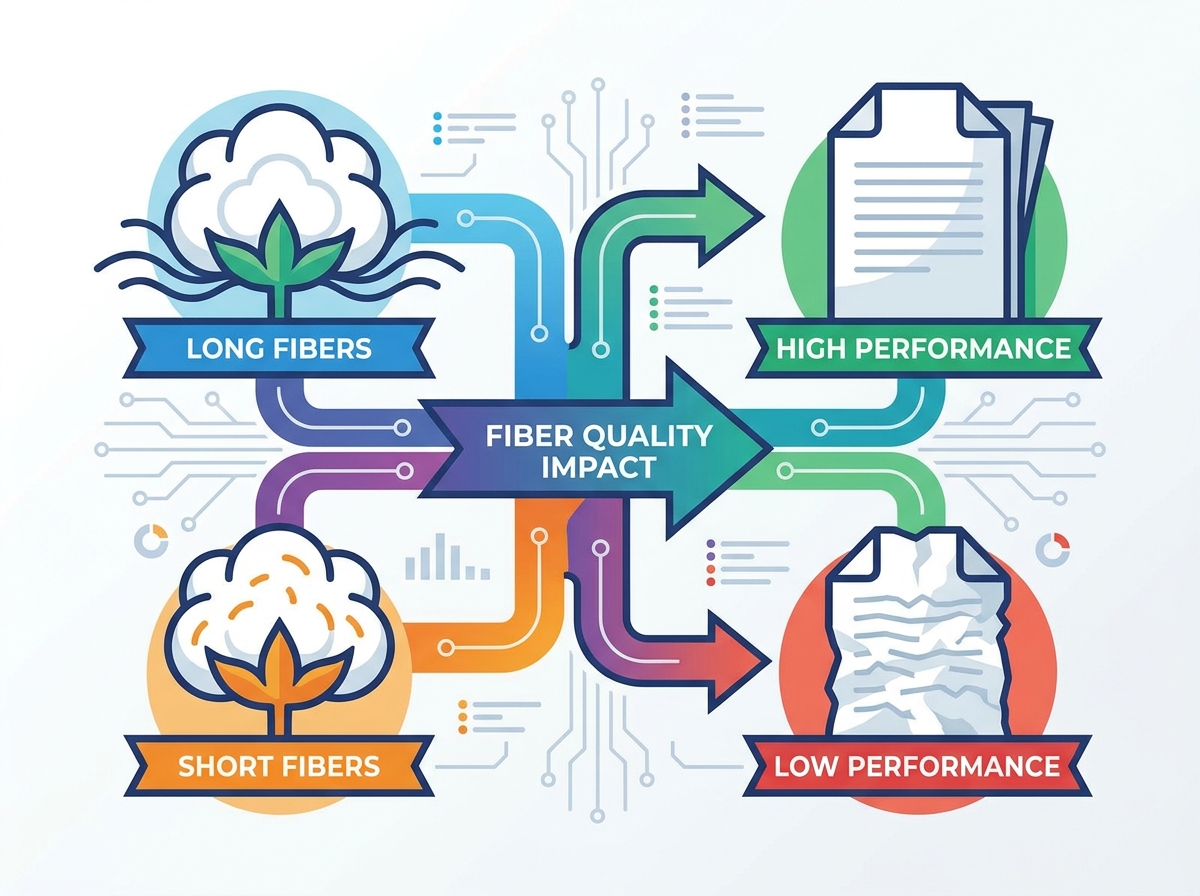
Fiber length directly correlates to the tear resistance and fold endurance of the final paper. Longer fibers distribute stress across a wider area of the sheet web, preventing localized failures. When a sheet is folded repeatedly, long fibers act as structural bridges. They maintain integrity long after short fibers would have snapped under the same mechanical load.
Coarseness plays an equally vital role, dictating the internal architecture of the sheet. High-coarseness fibers resist collapsing during the papermaking process. This resistance creates a more open sheet structure, significantly improving bulk, porosity, and absorbency. For filtration or absorbent grades, high coarseness is a primary requirement. You want the fibers to stay rigid and keep the fluid pathways open.
However, excessive coarseness introduces negative trade-offs. Because coarse fibers do not conform well to one another, they offer less surface area for fiber-to-fiber bonding. This results in lower overall tensile strength. Additionally, poorly bonded coarse fibers increase the risk of picking and linting. Loose fibers detach from the sheet surface, causing severe issues during printing or coating operations.
Fiber strength at the microscopic level dictates the absolute maximum strength the final web can achieve. If the individual fibers are weak, no amount of processing will yield a strong sheet. We test this rigorously before the pulp ever hits the refiners.
Equally important is a fiber's ability to fibrillate. Fibrillation is the process where the main fiber frays into microscopic fibrils without the main shaft breaking. These micro-fibrils dramatically increase the surface area available for hydrogen bonding. High fibrillation potential is essential for creating a dense, highly bonded, and robust sheet.
This microscopic strength directly impacts runnability on the paper machine. In textile manufacturing, fiber strength affects spinning efficiency and yarn strength. In papermaking, this translates to web stability. High raw fiber strength prevents the wet web from breaking as it travels through the high-speed sections of the paper machine, minimizing costly downtime.
Raw cotton contains non-cellulosic materials, primarily waxes and pectins, which must be removed through a scouring process. If scouring is incomplete, residual impurities remain on the fiber surface. These residuals severely affect the hydrophilic nature of the pulp. Waxes repel water, hindering the fiber's ability to hydrate and bond properly during papermaking.
Furthermore, residual impurities compromise the long-term archival stability of the paper. They introduce organic compounds that can oxidize and degrade over decades. Mill technicians monitor the scouring effluent closely to ensure complete removal of these contaminants.
Raw cotton fibers or rags cannot simply be mixed with water and formed into paper. They require intense mechanical processing to become viable papermaking pulp. This mechanical action happens in refiners or Hollander beaters.
Simply scouring cotton makes the fiber hydrophilic, but it does not provide the structural mechanisms needed for web strength. The fibers must be mechanically beaten. Beating hydrates the fibers, causing them to swell, and mechanically frays their surfaces to create the micro-fibrils necessary for hydrogen bonding.
This process involves a strict inverse relationship. As the beating degree increases, fibrillation increases, driving up tensile and burst strength. Simultaneously, the mechanical action cuts the fibers, decreasing the average fiber length. This reduction in length directly reduces tear strength. Operators must determine the optimal stopping point to balance these forces.
Assess End-Use Requirements: Determine if the final product prioritizes tear resistance (requires longer fibers) or tensile strength (requires high fibrillation).
Set Refiner Load: Adjust the mechanical pressure in the refiner to control the cutting versus brushing action on the fibers.
Monitor Freeness: Continuously measure the drainage rate (CSF) to track the progression of fibrillation and fine generation.
Halt Processing: Stop the beating process the moment the target freeness is achieved to prevent unnecessary fiber shortening.
Prolonged beating inevitably generates fine fibers, or fines. These microscopic fiber fragments significantly alter how the pulp behaves on the paper machine wire. High fines content drastically slows the drainage rate, as the fines plug the pores of the forming fabric, trapping water in the web.
An elevated ratio of fine fibers to long fibrillated fibers impacts physical sheet properties. Fines fill the voids between larger fibers, increasing sheet density and causing higher drying shrinkage. They also tend to reduce the opacity of the final sheet.
This dynamic has severe production cost implications. Slower drainage means the wet web enters the press section with higher moisture content. To compensate, operators must either reduce machine speeds to allow more time for drainage or consume significantly more thermal energy in the drying section to evaporate the excess water.
Beating Time | Fibrillation Level | Average Fiber Length | Drainage Rate (Freeness) | Primary Sheet Characteristic |
|---|---|---|---|---|
Low | Minimal | High | Fast | High tear strength, high porosity |
Medium | Moderate | Medium | Moderate | Balanced tensile and tear strength |
High | Extensive | Low | Slow | High tensile strength, dense sheet |
Different commercial and industrial use cases require vastly different fiber quality profiles. Matching the right pulp to the right application is the foundation of successful product development. You cannot use a filtration-grade pulp for an archival document.
Fine art and archival applications demand absolute chemical stability. The paper must feature high purity, a neutral pH, and total resistance to yellowing over centuries. Surface integrity is also critical. Low linting is required to prevent defects during printing.
The ideal fiber profile for these grades involves moderate beating. This ensures a smooth surface formation suitable for high-resolution ink deposition. The pulp must also exhibit low coarseness to prevent picking and linting during rigorous intaglio or offset printing processes.
In industrial composites, the paper acts as a structural reinforcement matrix. These applications require high flexural strength, pronounced strain-hardening behavior, and excellent adhesion to the surrounding matrix.
Resilient cotton rag pulp is ideal here. It offers high inherent fiber strength. The beating process must be optimized to provide enough fibrillation to anchor the fibers securely into the cementitious matrix, without over-processing that would destroy the natural springy, strain-hardening nature of the fiber.
Filtration media and absorbent sheets prioritize fluid dynamics over structural strength. They require high porosity, rapid fluid uptake, and specific micron-retention rates.
These grades demand high-coarseness fibers processed with a very low beating degree. Minimal beating preserves fiber length and prevents the generation of fines, maintaining an open internal pore structure that maximizes bulk and fluid flow.
Procuring raw materials requires strict oversight. Buyers must ask specific questions and demand rigorous testing to ensure consistent batch-to-batch quality. Do not rely on visual inspections alone.
The baseline potential of any cotton fiber is established long before it reaches the pulping facility. Cultivar and seed selection determine the absolute maximum fiber length and strength that can be achieved.
Crop management plays a decisive role. Nutritional deficiencies during the growing season permanently stunt fiber development. Severe potassium (K) deficiency, in particular, leads to thin-walled, weak fibers that will fail under mechanical stress during papermaking.
Environmental factors also dictate quality. Extreme weather events and high moisture levels during harvest can cause physical or microbial damage. This damage permanently reduces lint strength, rendering the fibers unsuitable for high-performance applications. Buyers must require supplier transparency regarding raw material sourcing and agricultural lot testing to avoid these degraded batches.
Sourcing involves choosing between post-industrial cotton rag, cotton linters, and virgin staple cotton. Each offers distinct performance and cost profiles.
Cotton linters are the short, residual fibers left on the seed after ginning. They are highly pure but structurally short, making them suitable for specialty chemical cellulose or low-strength specialty papers. Cotton rag pulp is recovered from textile offcuts. Because these fibers were originally selected for textile spinning, they are longer and highly resilient. However, the chemical history of rag pulp—including previous bleaching or dyeing in the textile process—can impact its behavior compared to raw linters, requiring careful evaluation.
Relying on visual inspection is insufficient. Buyers must demand comprehensive Certificates of Analysis (COA) detailing specific standard tests.
Critical metrics include Canadian Standard Freeness (CSF) to verify the exact beating degree and drainage potential. Fiber length analysis is necessary to ensure the pulp will meet tear strength requirements. Finally, dry and wet tensile strength metrics must be provided to confirm the structural viability of the batch before it enters production.
To consistently manufacture high-performance materials, engineers must treat fiber selection as a critical engineering variable. cotton pulp paper performance is highly dependent on the intersection of raw fiber quality and precise mechanical beating.
Request pilot-scale samples to validate drainage rates and machine runnability before committing to commercial volumes.
Review supplier COAs rigorously for fiber length, freeness, and agricultural origin data to mitigate batch variability.
Conduct application-specific stress tests, such as flexural testing for composites or print trials for fine art, on all new pulp batches.
Establish strict freeness parameters with your refiner operators to prevent over-beating and loss of tear strength.
A: Mechanical fibrillation is necessary to create hydrogen bonds. Scouring alone only makes the fiber hydrophilic, removing waxes and pectins. It does not fray the fibers. Without beating to create micro-fibrils, the fibers cannot interlock, resulting in a sheet with virtually no structural web strength.
A: Coarser fibers resist collapsing during the sheet formation and pressing stages. This structural rigidity creates a bulkier sheet with higher internal porosity. The open pore structure allows for much faster drainage on the machine and significantly higher fluid absorbency in the final product.
A: Cotton linters are the short, residual fibers scraped from cotton seeds after the primary ginning process. They are pure but short. Cotton rag pulp is sourced from textile offcuts, utilizing longer, highly resilient fibers originally graded for spinning, providing superior physical strength.
A: Extreme weather, poor crop management, or severe potassium deficiencies during crop growth stunt cell wall development. Additionally, high moisture during harvest leads to microbial damage. These factors result in inherently weaker lint strength, producing thin-walled fibers that break easily during pulping.
A: Cotton possesses a naturally high alpha-cellulose content and is virtually free of lignin. Wood pulps contain lignin, which causes acidic degradation and yellowing over time. Cotton's natural purity eliminates the need for harsh chemical bleaching, ensuring long-term chemical stability and physical endurance.
A: Yes. The resilient, twisted, and springy nature of cotton fibers provides superior strain-hardening and flexural performance. When used in composites like fiber cement, properly fibrillated cotton fibers anchor into the matrix, absorbing physical stress and preventing brittle failure far better than rigid wood fibers.