- All
- Product Name
- Product Keyword
- Product Model
- Product Summary
- Product Description
- Multi Field Search
English
Views: 0 Author: Site Editor Publish Time: 2026-07-07 Origin: Site

The significant price disparity between standard cellulose paper and 100% cotton paper forces buyers to justify the premium for fine art, luxury packaging, and archival applications. Selecting an inadequate paper substrate compromises long-term archival integrity, degrades print or medium application, and diminishes perceived brand value in luxury markets. Understanding exactly what cotton pulp paper is, the technical realities of its manufacturing process, and how it compares to wood pulp alternatives is essential for making evidence-based procurement and production decisions. We see this daily on the production floor. When you specify the wrong substrate, you risk immediate failure on the press or long-term degradation in the archive. You need to know the mechanical properties of the fibers you are buying to ensure your final product performs exactly as intended under physical stress and environmental exposure.
Superior Fiber Mechanics: Cotton pulp paper relies on naturally long, strong fibers (linters and textile rags) that provide exceptional tensile strength and dimensional stability compared to the short fibers of wood pulp.
Inherent Archival Stability: Naturally free of lignin—the compound that causes wood pulp paper to yellow and degrade—cotton paper offers centuries of archival durability without relying on heavy chemical buffering.
Manufacturing Variances Dictate Performance: The specific production method (soda process, cylinder mould vs. Fourdrinier machine, internal vs. external sizing) directly dictates the paper's suitability for specific applications like heavy water saturation or deep impression printing.
Cost-to-Value Justification: While upfront costs are higher, the investment is offset by the elimination of degradation risks in high-stakes applications (fine art, legal documents, luxury branding).
Defining the baseline requirements for premium paper establishes what legally and technically qualifies as a true cotton substrate in commercial markets. The composition primarily involves cotton linters, which are the short, silky fibers left on the seed after ginning. Papermakers also heavily utilize textile waste, such as denim and t-shirt scraps. Utilizing these pre-consumer scraps yields high-strength paper while reducing environmental impact. You cannot achieve the same mechanical tear resistance with standard wood cellulose.
Historically, the mid-19th-century rise of wood pulp manufacturing relegated cotton rag paper from a high-volume commodity to a premium, archival-grade specialty substrate. Chemically, cotton fibers are approximately 90% pure cellulose and naturally lack lignin. This natural absence of lignin contrasts sharply with wood cellulose, which requires intensive chemical extraction to achieve similar purity levels. When we evaluate raw materials at the mill, the purity of the incoming cotton directly dictates the chemical load required during the pulping phase.
Raw Material Source | Fiber Characteristics | Primary Application |
|---|---|---|
Cotton Linters | Short to medium length, high purity, highly absorbent. | Watercolor papers, fine art printmaking, museum boards. |
Textile Rags (Pre-consumer) | Extremely long, interwoven fibers, high tensile strength. | Currency paper, heavy-duty archival documents, luxury packaging. |
Wood Pulp (Reference) | Short, brittle fibers, requires heavy delignification. | Standard commercial printing, newsprint, temporary packaging. |
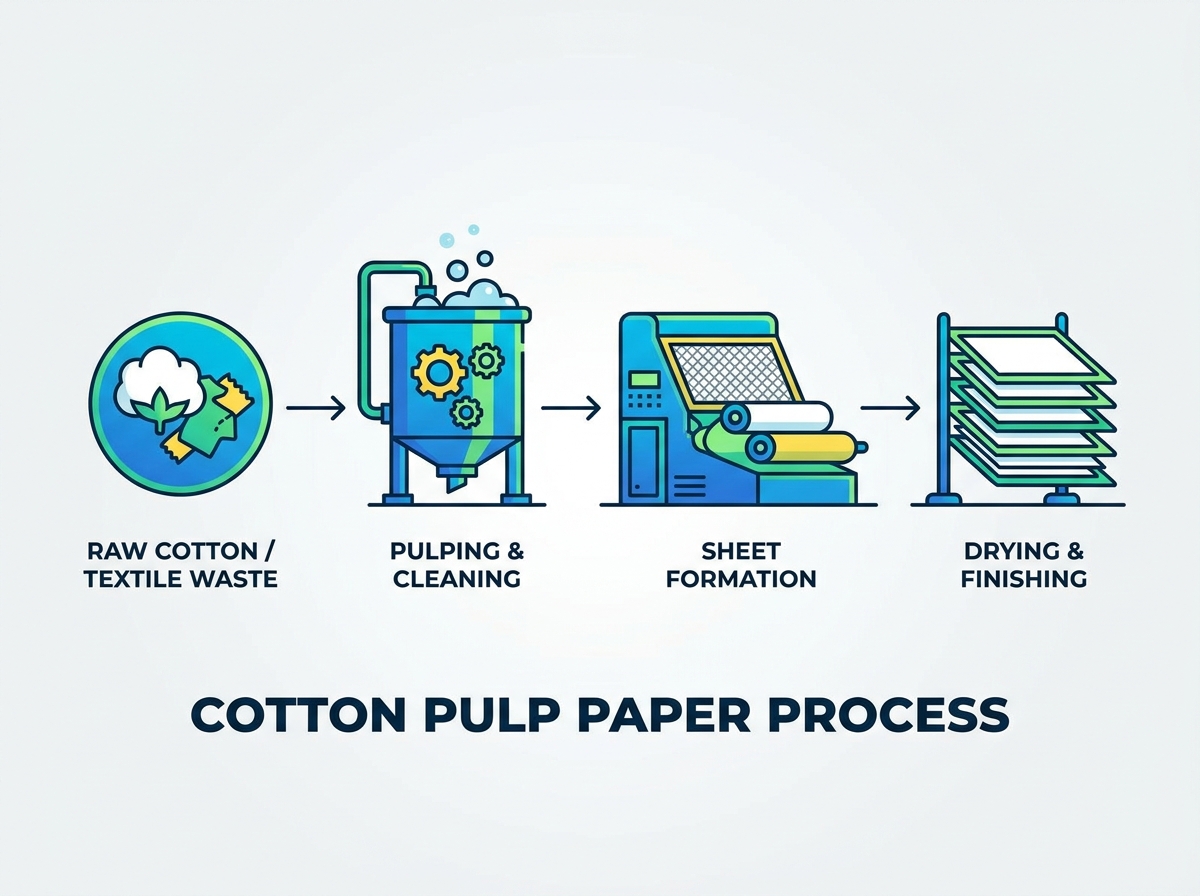
Breaking down the industrial papermaking process highlights where quality control impacts the final product. The process begins with raw material sourcing and preparation. Facilities sort and grade waste cotton, textile scraps, and linters. Processing post-consumer and industrial waste, such as upcycling t-shirt and denim scrap into unbleached, dye-free paper, minimizes chemical processing and carbon footprint. Mechanical cleaning and dusting remove non-fibrous debris before pulping. If you skip rigorous mechanical cleaning, you end up with abrasive inclusions in the final sheet.
The soda process handles delignification. Raw cotton materials cook using sodium hydroxide in pressurized digesters. This controlled cooking breaks down remaining natural waxes, pectins, and impurities without destroying the physical integrity of the long cotton fibers. Following the cooking stage, the pulp undergoes washing, bleaching, and beating. Beating utilizes a Hollander beater or refiner to fibrillate the cotton fibers. This increases surface area, hydration, and hydrogen bonding strength. Manufacturers evaluate the chemical and mechanical trade-offs of chlorine-free bleaching versus utilizing unbleached textile scraps for eco-friendly, zero-dye product lines.
Sorting and Grading: Incoming bales of linters and rags are manually and mechanically sorted to remove synthetic fibers and contaminants.
Digestion (Cooking): The raw cotton is boiled in a pressurized digester with sodium hydroxide to strip away waxes and pectins.
Washing and Bleaching: The cooked pulp is washed repeatedly to remove the alkaline liquor, followed by chlorine-free bleaching if a bright white sheet is required.
Beating (Fibrillation): The pulp passes through a Hollander beater, mechanically bruising the fibers to create microscopic hooks that interlock during sheet formation.
Sizing Application: Internal sizing agents like Alkyl Ketene Dimer (AKD) are added directly to the wet slurry to control internal water absorption.
Sheet formation and drying occur via machine or mould. Cylinder mould-made paper features slower, randomized fiber alignment. This yields superior multi-directional wet strength, low expansion when wet, and natural deckle edges, making it ideal for high-end watercolor and printmaking. Fourdrinier machine-made paper involves faster, highly directional fiber alignment. This results in uniform sheets with a distinct grain direction, ideal for high-speed commercial printing, folding, and rigid packaging.
Direct comparison frameworks assist buyers in choosing between 100% cotton substrates, cotton blends, and 100% wood pulp. Fiber length and mechanical strength vary significantly. Cotton's interlocking long fibers, typically 12 to 25 millimeters, withstand heavy friction, intense erasing, and deep letterpress impressions without tearing. Short wood fibers, measuring 1 to 3 millimeters, lack this resilience. When you run a deep deboss on a letterpress, wood pulp fibers snap at the crease. Cotton fibers stretch and compress, holding the impression flawlessly.
Archival quality and chemical stability also differ. Wood pulp requires intensive chemical removal of lignin and subsequent alkaline buffering to become acid-free. Cotton is inherently acid-free and lignin-free from the source. It offers superior longevity, resistance to yellowing, and structural preservation for museum-grade applications. You do not have to worry about the paper turning brittle and yellow after fifty years in a storage vault.
Absorption and sizing dynamics play a critical role. Cotton fibers absorb water internally, swelling the fiber itself. Wood pulp tends to pool water on the surface or oversaturate unevenly. Sizing controls ink bleed, feathering, and pigment suspension. Internal sizing is added to the pulp slurry, while external or tub sizing applies gelatin or starch to the dry sheet surface. We always check the sizing ratio before approving a batch for wet-media applications.
The Water Test: Assess pigment behavior and water distribution. Cotton provides smooth, controllable wet-on-wet gradients and slow, even drying times. Wood pulp exhibits pooling, quick drying, and hard backrun edges.
Tactile and Visual Cues: Assess surface texture. Cotton offers warmth, organic tooth, and soft compressibility. Wood pulp feels cold, rigid, and uniformly flat. The tear test reveals long, fuzzy, interlocking cotton fibers versus short, clean, brittle wood pulp fractures.
Erasing and Scrubbing Resilience: Evaluate the surface resistance to pilling, tearing, or shedding under repeated physical friction and moisture application.
Fine art and watercolor applications demand specific success criteria. The paper must maintain dimensional stability under heavy water loads. It requires pigment lifting capabilities without damaging the surface sizing and resistance to scrub pilling. If the internal sizing fails, the watercolor pigment sinks dead into the core of the paper, losing all luminosity.
Luxury packaging and letterpress stationery require compressibility for deep, tactile impressions like debossing and embossing. The paper must not crack on fold lines. It must provide a premium hand-feel and exceptional edge-gilding integrity. We frequently see packaging fail at the hinge because the buyer specified a short-fiber wood pulp board instead of a cotton-reinforced substrate.
Archival document preservation and legal certificates necessitate compliance with ISO 9706 standards for permanent paper. The substrate must resist oxidation and pollution while maintaining mechanical handling durability over centuries of storage. Government archives and legal registries mandate these specifications to prevent catastrophic data loss over time.
Balancing extreme performance requirements against commercial budget constraints influences overall value. Specifying 100% cotton suits premium needs, while a 25% cotton and 75% alpha-cellulose blend optimizes high-volume corporate branding budgets without sacrificing tactile prestige. You have to look at the mechanical demands of the final product before committing to a 100% rag sheet.
Sustainability and environmental impact require evaluation. Upcycling pre-consumer textile waste reduces landfill burden. Buyers must weigh this against the water and energy intensity of the agricultural cotton crop and pulping process. Sourcing from mills that utilize closed-loop water systems mitigates the environmental footprint of the washing and bleaching stages.
Implementation risks require mitigation strategies. Inconsistent sizing across batches affects print runs, ink drying times, and watercolor absorbency. Mitigate this by requesting mill-specific sizing data sheets, verifying internal and surface sizing ratios, and conducting small-batch test runs before large-scale procurement. Supply chain volatility in premium textile scrap sourcing can impact paper color and texture consistency. If you need help navigating these procurement risks, you can always contact us for a technical consultation.
Cotton pulp paper stands apart from ordinary wood pulp paper because of its long cellulose fibers, natural lignin-free composition, strength, absorbency, and long-term stability. These characteristics explain why it remains a preferred material for watercolor painting, fine art printing, archival documents, letterpress stationery, and luxury packaging.
However, cotton content alone does not determine performance. Fiber source, beating, sheet-forming method, sizing, surface texture, and manufacturing consistency all influence how the paper responds to water, ink, pressure, folding, and long-term storage. A 100% cotton sheet may be appropriate for demanding artistic or archival work, while a cotton blend can provide a more practical balance for commercial applications.
Ultimately, the best paper is not simply the most expensive option. It is the substrate whose structure and production method match the requirements of the final product.
A: Cotton paper utilizes long cotton fibers, offering superior strength, durability, and natural archival qualities. Regular paper uses short wood pulp fibers, requiring intensive chemical treatment to remove lignin and achieve acid-free status.
A: Yes. Cotton fibers absorb water internally, allowing for smooth gradients, longer drying times, and better dimensional stability without buckling or pilling under heavy washes.
A: Tearing the paper reveals long, fuzzy fibers at the edge. Cotton paper also feels softer, handles heavy erasing without tearing, and absorbs water evenly compared to wood pulp paper.
A: The raw materials, such as linters and textile scraps, cost more than wood pulp. The specialized manufacturing processes, like cylinder mould production and extensive beating, also increase production expenses.
A: No. Cotton fibers naturally lack lignin, the compound responsible for paper yellowing and degradation, making cotton paper inherently archival and stable for centuries.
A: Internal sizing mixes into the pulp slurry to control overall water absorption. External sizing applies to the dry sheet surface to manage ink holdout, prevent feathering, and protect the paper surface.