
- All
- Product Name
- Product Keyword
- Product Model
- Product Summary
- Product Description
- Multi Field Search
English
Views: 0 Author: Site Editor Publish Time: 2026-07-17 Origin: Site


When executing heavy wet-on-wet watercolor techniques, standard paper often fails mechanically. Artists frequently encounter surface pilling, aggressive buckling, and uncontrollable pigment pooling. These issues disrupt the painting process and ruin carefully planned gradients. The root cause lies in the structural limitations of short-fiber wood pulp, commonly known as cellulose, which breaks down under high moisture loads and repeated brush friction.
To achieve professional results, artists must upgrade their materials. Using cotton pulp paper serves as the technical standard for heavy washes. Its unique fiber mechanics and sizing chemistry provide superior resilience and moisture control. This article breaks down the science behind fiber structures, sizing applications, and the performance trade-offs for artists evaluating material upgrades.
Fiber Mechanics: Cotton pulp paper utilizes long, naturally intertwined fibers that expand evenly, allowing for maximum water absorption without structural degradation.
Surface Resilience: Unlike wood pulp, 100% cotton paper withstands aggressive lifting, scrubbing, and reworking without pilling or tearing.
Pigment Suspension: Cotton fibers hold paint closer to the surface while absorbing the water vehicle, resulting in cleaner gradients and preventing muddy "cauliflower" blooms.
The Weight Fallacy: Paper weight (e.g., 300gsm/140lb) dictates thickness, but material composition (cotton vs. cellulose) dictates performance; heavy wood pulp will still buckle and pill under heavy washes.
The microscopic structure of cotton linters reveals long, durable, and naturally interlocking fibers. These characteristics provide immense tensile strength, especially when the paper becomes saturated. When you flood a sheet with a heavy wash, the long fibers stretch and recover. They hold onto each other, maintaining the sheet's integrity even under heavy water loads. Conversely, wood cellulose consists of short, brittle fibers that have been chemically broken down during manufacturing. When wet, short fibers lose their grip on one another, leading to rapid structural failure.
Fiber length directly correlates to the paper's ability to handle stress. Short wood fibers simply separate, causing the paper surface to degrade quickly under the friction of a brush. If you use a stiff synthetic brush to lift a mistake on cellulose, you will immediately notice the surface tearing. On cotton, the interlocking network resists this abrasion, allowing you to scrub the surface repeatedly without destroying the tooth.
Feature | Cotton Pulp | Wood Pulp (Cellulose) |
|---|---|---|
Fiber Length | Long, interlocking | Short, brittle |
Wet Tensile Strength | High (resists tearing) | Low (prone to pilling) |
Water Absorption | Even, deep saturation | Surface pooling, uneven |
Archival Quality | Naturally acid-free | Requires chemical treatment |
Sizing refers to the application of gelatin or synthetic alternatives to control water absorption. Without sizing, watercolor paper behaves like a sponge, immediately soaking up pigment and water, leaving colors looking dead and flat. Professional grade sheets typically feature both internal and external (tub) sizing. This dual application regulates moisture penetration while keeping the pigment suspended on the surface.
Internal sizing protects the core fibers. It is mixed directly into the vat during the papermaking process. External sizing creates a resilient barrier on the outside of the sheet. The paper is run through a gelatin bath, coating the exterior. This combination allows the paper to handle heavy washes without acting like blotting paper, ensuring colors remain vibrant and workable. When you drop heavy pigments like French Ultramarine onto a well-sized sheet, the pigment particles float and settle into the texture, rather than sinking into the core.
Cotton fibers possess a natural hollow structure that enables superior capillary action. This hollow core draws water evenly throughout the sheet. The natural interlocking network facilitates lateral water distribution, preventing dry spots and ensuring uniform saturation. When you pre-wet a sheet, you can watch the water absorb evenly across the surface.
Uniform saturation is critical for smooth washes. Because the water distributes evenly, the paper remains consistently damp, giving the artist ample time to manipulate pigments without rushing against uneven drying rates. Here is how the saturation process works mechanically:
Water is applied to the surface and breaks the surface tension of the external sizing.
The hollow fibers draw the moisture inward through capillary action.
Moisture spreads laterally across the interlocking fiber network.
The sheet reaches maximum saturation, holding water internally while the surface remains glossy and workable.
Surface pilling occurs when short wood fibers detach from the paper matrix. Under the friction of a wet brush, especially during scrubbing or lifting techniques, cellulose fibers easily break loose. These detached fibers roll up into small pills across the surface, ruining the texture and trapping pigment unevenly. If you try to glaze a second layer over a pilled surface, the pigment will catch on the loose fibers, creating dark, ugly spots.
This abrasion vulnerability severely limits an artist's ability to correct mistakes or apply multiple glazes. Once the surface pills, the structural damage is permanent. You cannot sand it down or fix it. The painting is effectively ruined. This is why artists working with heavy layers or aggressive techniques find cellulose impossible to use.
Cellulose paper forces water to pool on the surface rather than absorbing it evenly. This pooling creates unpredictable drying times across the sheet. When a wet area bleeds into a partially dry area, it pushes pigment outward, forming hard edges known as blooms or backruns. These are often referred to as "cauliflower" blooms due to their fractal, jagged appearance.
These blooms disrupt smooth gradients and create unwanted textures. The lack of uniform moisture retention makes controlling heavy washes on wood pulp highly frustrating. If you are painting a clear, graded sky, a single bloom can destroy the illusion of depth. The water simply has nowhere to go on cellulose, so it sits on top, evaporating at different rates depending on the ambient humidity and the thickness of the water puddle.
Wood pulp expands erratically when wet. Even heavy 300gsm cellulose paper warps aggressively under high moisture loads. The short fibers swell and push against each other unevenly, causing the sheet to buckle into hills and valleys. When you apply a heavy wash, the paper immediately reacts, curling up at the edges and forming deep ridges in the center.
Once warped, cellulose paper strongly resists flattening after drying. The uneven surface causes wet pigment to flow into the valleys, further complicating wash control and resulting in uneven color distribution. You end up fighting the paper instead of focusing on the painting. The pigment settles into the low points, creating dark streaks that are impossible to lift out once dry.
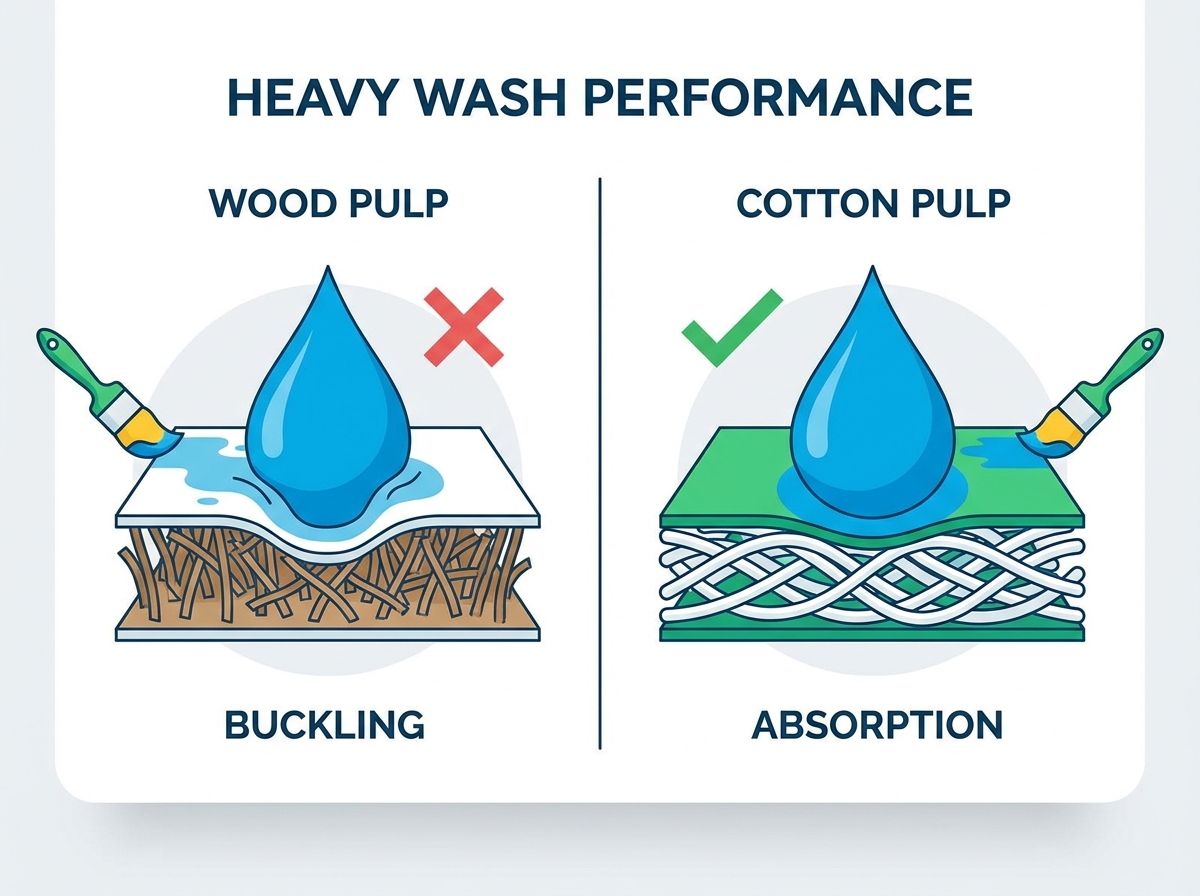
The material acts as a reservoir, holding water internally while keeping the surface workable for extended periods. This moisture retention allows artists to execute large-scale washes without the paper drying out prematurely. When painting a complex landscape, you need the sky area to remain wet while you drop in distant mountains. The internal reservoir provides that necessary working time.
The even distribution of water ensures gradient smoothness. Pigments flow naturally across the damp surface, blending seamlessly without forming harsh lines or dry patches. You can tilt the board and watch the pigment travel smoothly down the sheet, guided by gravity and the even moisture layer. This predictability is what separates professional materials from student-grade alternatives.
The physics of lifting pigment rely on a durable surface. The long, interlocking fibers withstand the friction of a stiff brush. Artists can re-wet specific areas and scrub out mistakes without destroying the paper's tooth. If you accidentally paint a shadow too dark, you can take a damp synthetic brush, agitate the pigment, and lift it away with a paper towel.
This forgiving reworkability is essential for complex paintings. It allows for precise highlights and corrections that would instantly destroy a cellulose surface. You can lift out clouds from a wet sky, or reclaim white highlights on a portrait, knowing the paper will not pill or tear under the pressure.
Wood pulp contains lignin, a natural polymer that causes paper to yellow and become brittle over time. Think of an old newspaper left in the sun; it turns yellow and crumbles within days. While some cellulose papers are chemically treated to remove lignin, 100% cotton is naturally lignin-free and acid-free from the start.
This inherent archival stability ensures that artwork remains vibrant and structurally sound for decades. If you are selling your work or submitting it to galleries, archival stability is non-negotiable. Collectors expect paintings to last lifetimes, making naturally acid-free materials the only acceptable choice for professional pieces.
Many artists mistakenly believe that upgrading to a heavier wood pulp paper, such as 425gsm or 640gsm, will solve heavy wash issues. However, paper weight only dictates thickness. If the fiber composition remains cellulose, the paper will still pill and warp under stress. A thick piece of wood pulp is still wood pulp.
Thickness cannot compensate for short, brittle fibers. Material composition always dictates performance, making fiber type the primary consideration over weight. A 300gsm cotton sheet will vastly outperform a 640gsm cellulose sheet in terms of moisture retention, lifting capability, and overall durability.
Different textures handle high water volumes differently. Hot Press paper has a smooth surface that causes water to pool, making heavy washes difficult to control. It is excellent for botanical illustration and fine ink work, but it struggles to hold large volumes of water without the pigment sliding around uncontrollably.
Rough and Cold Press textures feature distinct peaks and valleys that hold water and pigment securely. For maximum water retention and pronounced pigment granulation, Rough or Cold Press is highly recommended. These textures provide the necessary grip for layered wet-on-wet applications. The texture catches heavy pigment particles, creating beautiful, organic granulation effects that are highly sought after in watercolor painting.
Papers featuring 25% or 50% cotton blends serve as a middle-ground for light washes. They offer slightly better durability than pure cellulose but ultimately fail under heavy, layered wet-on-wet techniques. Manufacturers create these blends to offer a cheaper alternative, but they inherit the weaknesses of the wood pulp they contain.
The compromise is rarely worth it for serious watercolor work. The cellulose content in blends still limits moisture retention and surface resilience, eventually reaching a failure threshold during aggressive scrubbing. If you push a 50% blend too hard, it will pill just like a standard cellulose sheet. For heavy washes, you need the uncompromised strength of pure, long-fiber material.
A common objection among beginners is that professional paper is too expensive for practice. However, fighting poor-quality materials hinders skill development. Cellulose paper behaves unpredictably, making it impossible to learn proper water control. If the paper dries too fast or blooms constantly, the student assumes they lack skill, when in reality, the material is failing them.
Practicing on inferior paper teaches bad habits. You learn to use less water to avoid buckling, which leads to dry, overworked paintings. Investing in quality materials accelerates learning by providing consistent, reliable feedback during the painting process. You learn how water and pigment actually behave when they are not restricted by the surface.
The fear of wasting expensive sheets often reduces an artist's painting frequency. This psychological barrier, known as paper anxiety, stunts creative growth. You stare at a pristine white sheet, terrified of making a mistake. To maximize value, artists can tear down large imperial sheets (22" x 30") into budget-friendly fractions. Tearing a full sheet into eighths provides eight high-quality practice pieces for a fraction of the cost of a pre-bound block.
Painting on both sides of a high-quality sheet effectively doubles the usable surface. The back of the sheet may have a slightly different texture, but it performs identically in terms of water retention and durability. Cheap pulp paper should be reserved strictly for mechanical brush drills, testing color mixes, or swatching new palettes.
Evaluating the true cost requires a realistic ROI framework. The cost of wasted time, ruined expensive pigment, and discarded cellulose paper quickly adds up. If you spend three hours on a painting only to have it ruined by a cauliflower bloom in the final stages, that time is lost forever. A higher initial investment yields a significantly higher success rate.
Fewer ruined paintings mean less wasted material overall. The performance reliability ultimately provides better long-term value than constantly replacing failed cellulose sheets. When you factor in the cost of professional tube paints, wasting them on paper that cannot handle the medium is a poor economic decision.
The material requires more water to achieve the same surface saturation as cellulose. Artists switching materials must adjust their water control to avoid dry, patchy washes. Because the hollow fibers absorb so much moisture, a brush load of water that would flood a cellulose sheet will simply sink into a professional sheet.
Pre-wetting the sheet thoroughly and stretching the paper maximizes its capacity. Allowing the water to sink into the core fibers before applying pigment ensures a smooth, workable surface. You may need to re-wet the back of the sheet or use a spray bottle to keep the surface glistening before you drop in your main washes.
Cheap brands often suffer from poor external sizing. Insufficient sizing causes the paper to absorb pigment too deeply, leading to dull, sunken colors. This inconsistency ruins the vibrancy of watercolor paints. You might buy a cheap block thinking you found a great deal, only to find your paintings look like they were done on a paper towel.
Always test paper scraps before committing to a large wash. Apply a quick stroke of heavy pigment to check if the color remains vibrant on the surface or sinks into the fibers. If the pigment sinks immediately and loses its luster, the sizing is defective. You can sometimes salvage these sheets by applying a layer of watercolor ground, but it alters the texture significantly.
Executing a direct comparison test on a single sheet of pulp and a sheet of professional material side-by-side reveals the mechanical differences clearly. Tape down both samples on a rigid board. Mix a large puddle of a granulating pigment, like Cerulean Blue, and apply a heavy variegated wash to each.
Perform a lifting drill by scrubbing a damp brush over a dried area on both sheets. Finally, execute wet-on-wet glazing by dropping a second color into a damp section. The visual observation of pilling, blooming, and buckling on the cellulose, compared to the smooth performance of the professional sheet, will confirm the necessity of the upgrade.
To master heavy washes and wet-on-wet techniques, upgrading your surface material is a functional necessity. The structural integrity and moisture retention of long-fiber sheets prevent the mechanical failures common to wood pulp. Implement the following steps to improve your painting process immediately:
Purchase a small sample pack or a 9x12 block of 100% cotton Cold Press paper (300gsm) to test the moisture retention.
Run a side-by-side heavy wash comparison against your current cellulose paper to observe the difference in buckling and pigment suspension.
Tear large imperial sheets into smaller fractions to overcome paper anxiety and build a stockpile of high-quality practice sheets.
Reserve your remaining wood pulp paper strictly for dry-brushing, ink-and-wash sketches, or color swatching.
A: It depends on the technique. No, it is not necessary for light washes, sketching, or ink-and-wash. Yes, it is absolutely necessary for heavy wet-on-wet techniques, multi-layered glazing, and aggressive lifting, as cellulose will pill and buckle.
A: Paper weight dictates thickness, not fiber material. Heavy cellulose paper still warps because short wood fibers expand erratically when wet. Only long cotton fibers provide the structural integrity needed to resist severe buckling.
A: Cotton pulp utilizes long, interlocking fibers that offer superior durability, even water absorption, and natural archival (lignin-free) qualities. Wood pulp consists of short, brittle fibers that pill under friction, absorb water unevenly, and can yellow over time.
A: Blends handle moderate water better than pure cellulose, but they still have a low failure threshold. Under heavy scrubbing or saturated wet-on-wet layers, the cellulose content will cause the paper to pill and warp.
A: Dull colors usually result from insufficient water usage or poor external sizing. Cotton absorbs more water vehicle than wood pulp, so you must use more water. If the sizing is weak, the pigment sinks too deeply into the fibers.
A: No. 100% cotton is naturally lignin-free and acid-free, making it highly archival. Untreated wood pulp contains lignin, which causes yellowing and brittleness as the paper ages.
A: Purchase 22" x 30" imperial sheets in bulk and cut them down to smaller sizes. Utilize both sides of 300gsm sheets for practice. Reserve cheap cellulose paper strictly for dry-brushing, pigment mixing, and swatching.


